
Commercial Alarm Event Planning
A commercial alarm system should do more than detect activity. It should also define what happens after an alarm, trouble, supervisory condition, or other system event occurs.
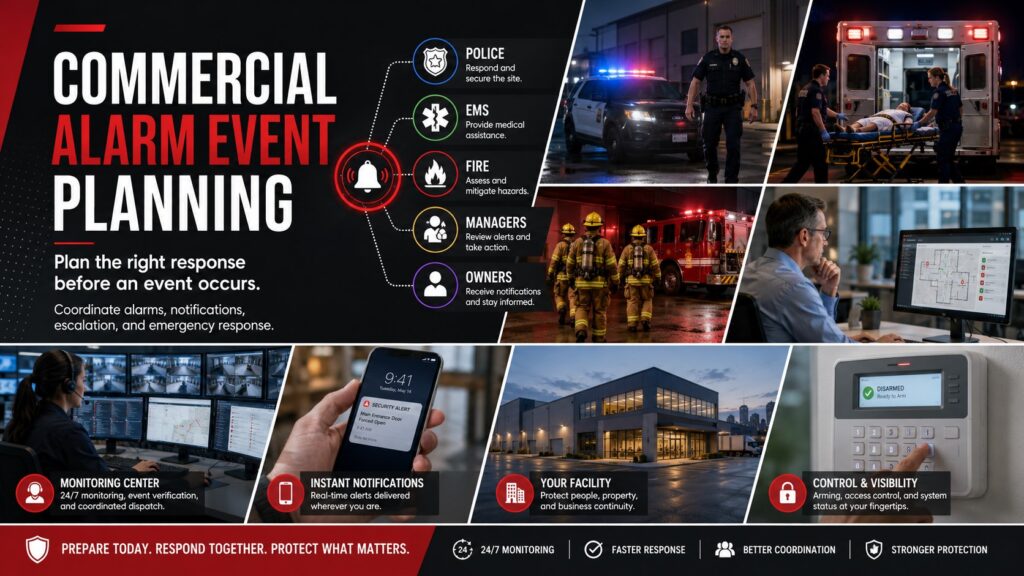
Commercial alarm event planning establishes how different security events are identified, transmitted, verified, escalated, and documented. This can help businesses create a more organized response to intrusion alarms, panic events, communication failures, environmental conditions, and other security-related activity.
For warehouses, manufacturing facilities, offices, schools, healthcare properties, municipal buildings, retail locations, and multi-site operations, event planning can make the difference between simply receiving an alarm and having a coordinated response strategy.
What Is Commercial Alarm Event Planning?
Alarm event planning is the process of determining how the security system should respond to different conditions.
An alarm system may generate events for:
- Door openings
- Motion detection
- Glass break detection
- Panic or duress activation
- Forced entry
- System tampering
- Communication failure
- AC power failure
- Low battery
- Device trouble
- Environmental conditions
- Arming and disarming activity
- Area or partition alarms
Each event may require a different response.
The objective is to establish that response before an emergency occurs.
Not Every Alarm Event Is the Same
Commercial alarm systems can generate many different event types.
A rear warehouse door alarm at 2:00 a.m. may require a different response than an employee panic button during normal business hours.
Likewise, a low battery trouble condition does not normally require the same urgency as a confirmed intrusion event.
Good event planning separates conditions by priority.
Typical categories may include:
Emergency events such as panic, duress, or verified intrusion.
Security events such as unauthorized entry or motion after hours.
Supervisory events that indicate a condition requiring attention.
Trouble events such as communication failure or low battery.
Administrative events such as arming, disarming, or user activity.
Alarm Zone Identification
Clear zone identification is one of the most important parts of event planning.
A monitoring center or manager should receive useful information such as:
- Front employee entrance
- Rear warehouse overhead door
- Shipping office motion detector
- Server room
- Reception panic button
- Loading dock glass break detector
Descriptions such as “Zone 14” or “Motion 3” provide much less useful information during an actual incident.
Accurate descriptions improve response and make event history easier to understand.
Priority Levels
Commercial systems can be programmed so different events receive different levels of attention.
For example:
High priority: Panic, duress, verified intrusion, critical perimeter event.
Medium priority: Interior intrusion, after-hours door activity, repeated alarm conditions.
Lower priority: Low battery, AC loss, device trouble, communication trouble.
The exact priorities depend on the facility and monitoring arrangement.
Who Should Be Contacted?
A commercial alarm plan should identify who is responsible for receiving alarm-related calls or notifications.
The contact list may include:
- Business owners
- Facility managers
- Security personnel
- Operations managers
- Property managers
- Designated employees
Contact lists should be kept current.
Outdated names, disconnected phone numbers, or former employees can significantly slow down response.
Establishing an Escalation Order
Many businesses need more than one contact.
A typical escalation plan might identify:
- Primary facility contact
- Secondary manager
- Security supervisor
- Additional emergency contact
The business should decide how many people should be contacted and in what order.
This is especially important for facilities that operate around the clock or have multiple shifts.
Panic and Duress Event Planning
Panic and duress alarms require special consideration.
The organization should determine:
- Which devices are silent
- Which devices activate audible notification
- Who receives the event
- What information is transmitted
- How employees should respond
- Whether video should be reviewed
- What procedures follow accidental activation
Employees should understand these procedures before the devices are needed.
Intrusion Event Planning
Intrusion alarms can originate from:
- Door contacts
- Motion detectors
- Glass break detectors
- Overhead door contacts
- Roof hatches
- Perimeter sensors
Event planning should determine how these alarms are handled.
For example, a company may want different procedures for:
- Exterior perimeter alarms
- Interior motion alarms
- High-value storage alarms
- Warehouse alarms
- Office alarms
- Server room alarms
Clear distinctions can help personnel understand the seriousness and location of each event.
Alarm Verification
Some businesses use additional information to help verify alarm conditions.
Depending on the security system, verification may involve:
- Multiple alarm zones
- Video surveillance
- Audio information
- Sequential detection
- Access control events
For example, an exterior door alarm followed by an interior motion event can provide more information than a single sensor activation.
Video surveillance can also help determine what occurred in the affected area.
Video Integration
Alarm events can be more useful when associated with nearby cameras.
If the systems are integrated, an alarm event may help management or security personnel quickly identify video from:
- Entrances
- Loading docks
- Warehouses
- Hallways
- Cash-handling areas
- Restricted rooms
This can support investigation, verification, and documentation.
Communication Failure Events
The alarm communication path should also be monitored.
Modern commercial systems may use:
- Cellular
- Ethernet/IP
- Dual-path cellular and IP
- Private radio
If a communication path fails, the system may generate a trouble condition.
Businesses should decide who needs to know about communication failures and how quickly the condition should be investigated.
Power Failure and Battery Events
Commercial alarm systems normally contain backup batteries.
When AC power is lost, the system may continue operating temporarily from battery power.
Event planning should establish procedures for:
- AC power loss
- Low battery
- Extended outages
- Battery failure
- Restoral of normal power
A short utility interruption may require monitoring only, while an extended outage could require onsite attention.
Arming and Disarming Events
Commercial alarm systems can also generate events when employees arm or disarm protected areas.
These records can help management understand:
- Who opened the facility
- Who closed the facility
- What time activity occurred
- Whether a location was left unarmed
- Whether employees entered outside normal hours
Individual user codes are more useful than shared codes because they provide better accountability.
Exception Reporting
Some businesses do not need a notification every time the alarm system is disarmed.
Instead, they may want alerts only when something unusual happens.
Examples include:
- Facility not armed by a certain time
- Facility opened unusually early
- Alarm disarmed on a weekend
- Restricted area accessed after hours
- Repeated alarm conditions
Exception reporting can help reduce unnecessary notifications while highlighting activity that requires attention.
Partition and Area Event Planning
Larger commercial systems may divide a property into multiple alarm areas or partitions.
For example:
- Main office
- Warehouse
- Manufacturing floor
- Shipping department
- Server room
- Executive area
Each area can have different schedules and event procedures.
This is particularly useful when parts of the building operate while other sections remain armed.
Multi-Site Alarm Event Planning
Businesses with multiple facilities should consider standardizing alarm event procedures.
Consistency can help provide:
- Common zone naming
- Standard contact procedures
- Similar escalation rules
- Consistent alarm priorities
- Easier employee training
- Better event reporting
This can simplify security management across a larger organization.
Reviewing Alarm History
Alarm event history can reveal recurring issues.
Businesses should periodically review events for:
- Repeated false alarms
- Doors causing frequent trouble
- Communication problems
- Employees repeatedly forgetting to arm
- Low battery conditions
- Unusual after-hours activity
Patterns can help identify maintenance problems, operational issues, or security weaknesses.
Testing the Response Plan
Alarm devices should be tested, but the response procedure should also be reviewed.
A business may want to confirm:
- Contact lists are correct
- Employees understand panic procedures
- Monitoring instructions are current
- Zone descriptions are accurate
- Communications are functioning
- Managers know how notifications are handled
A plan that has never been reviewed can become outdated quickly.
Questions to Address During Alarm Event Planning
Before finalizing an event strategy, consider:
- Which alarm events are most critical?
- Who should receive each event?
- What is the escalation order?
- Are panic alarms silent or audible?
- Are zone descriptions clear?
- Should video be reviewed during an alarm?
- Are communication failures reported?
- Are power and battery events monitored?
- Are arming and disarming events important?
- Are multiple buildings or partitions involved?
- How often are contact lists reviewed?
The answers should reflect the actual way the facility operates.
Build the Response Around the Facility
Commercial alarm event planning should be designed around the organization, not simply the equipment.
A warehouse operating three shifts requires a different response plan than a professional office that closes at 6:00 p.m.
A healthcare facility may have different panic procedures than a distribution center.
A multi-site company may require centralized escalation and consistent event naming across every location.
The alarm system should support those operational requirements.
For more information about intrusion detection, alarm monitoring, system configuration, and commercial facility protection, visit Northeast Remote Surveillance and Alarm’s commercial alarm system installation guide.
Planning Commercial Alarm Events?
A well-designed alarm system should identify what happened, where it happened, and how the event should be handled.
Establishing event priorities, contact procedures, zone descriptions, escalation paths, verification methods, and system-trouble procedures can help businesses turn alarm signals into a more organized security response.