
Commercial Alarm Power Loss Prevention and Battery Backup Power Planning
A commercial alarm system needs dependable power during normal operation and a planned method of continuing critical functions when utility power is lost.
Power interruptions can result from utility failures, storms, electrical work, equipment problems, tripped breakers, building shutdowns, or failures elsewhere in the property’s electrical infrastructure. A properly designed commercial security system should detect the loss of primary power, transition to its available standby source, report trouble conditions when appropriate, and maintain the equipment required for continued protection.
For warehouses, manufacturing facilities, offices, healthcare properties, schools, municipal buildings, distribution centers, and multi-site businesses, alarm power-loss prevention should be considered during initial system design rather than after an outage occurs.
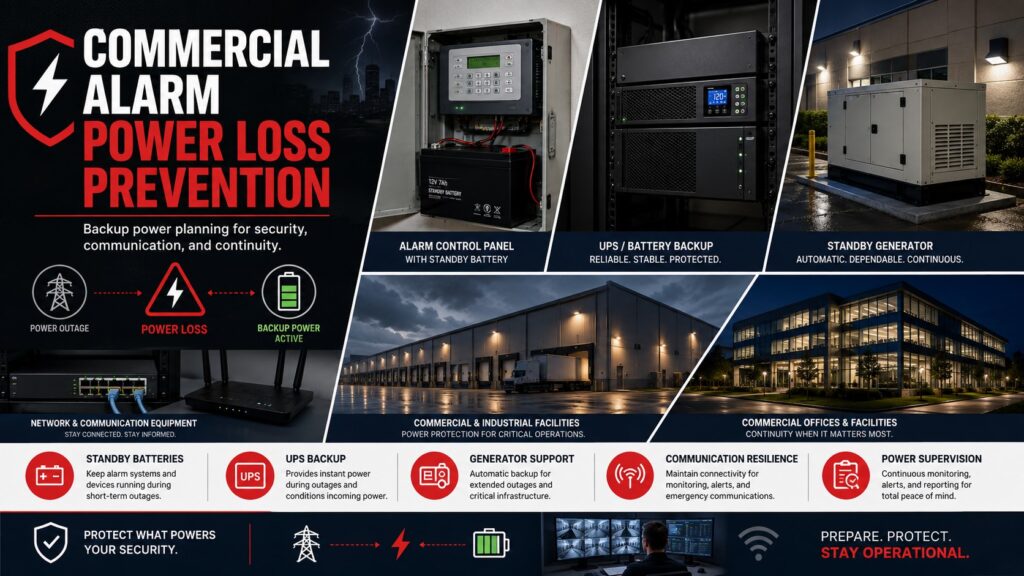
What Happens When an Alarm System Loses AC Power?
Most commercial alarm control equipment operates from building AC power through a power supply or transformer.
When primary power disappears, properly designed systems can transition to standby batteries or another approved backup source.
Depending on the system, a power failure may generate:
- AC power-loss trouble
- Low-battery trouble
- Power-supply trouble
- Communication trouble
- Remote notification
- Monitoring-center notification
- Event history showing when power failed and returned
The objective is to identify the problem before backup power is exhausted.
Standby Batteries
Rechargeable batteries are one of the most common backup-power methods used with alarm equipment.
They may provide standby power for:
- Intrusion alarm panels
- Fire alarm control panels
- Security communication equipment
- Access control equipment
- Auxiliary power supplies
- Wireless receivers
- Notification equipment
- Other compatible security devices
Battery capacity should be calculated around the actual system load rather than simply installing whatever battery happens to fit inside the enclosure.
For fire alarm systems, NFPA guidance includes secondary-power requirements intended to keep the system operating after primary power is lost. NFPA’s fire-alarm guidance describes the familiar 24-hour standby requirement followed by required alarm operation, with the exact alarm duration depending on the system type and applicable requirements. (NFPA)
For commercial fire-alarm requirements, see NFPA 72 and Commercial Fire Alarm Systems from Northeast Remote Surveillance and Alarm.
Battery Capacity Matters
A battery that powers a small intrusion panel may not be adequate after additional equipment is added.
System expansion can increase standby load through:
- Additional keypads
- Wireless receivers
- Cellular communicators
- Network communicators
- Expansion modules
- Motion detectors
- Glass break detectors
- Powered sensors
- Auxiliary devices
Whenever equipment is added, the available power and standby capacity should be reviewed.
A system can appear to operate normally on AC power while having inadequate capacity during an extended outage.
Aging Batteries
Rechargeable standby batteries do not last indefinitely.
Age, temperature, charging conditions, repeated discharges, and equipment load can reduce available capacity.
Warning signs can include:
- Recurring low-battery troubles
- Batteries that fail testing
- Swelling or physical deterioration
- Rapid voltage drop after AC loss
- Trouble conditions after short outages
- Batteries significantly beyond their expected service life
Battery condition should be included in routine alarm-system inspection and maintenance.
AC Power Supervision
An alarm panel should be able to identify when its normal power source disappears.
This allows the system to recognize that it is operating on backup power rather than waiting until the batteries are nearly depleted.
For professionally monitored systems, AC-loss events may be reported according to system programming and monitoring procedures.
Businesses should determine:
- Who receives AC-loss notifications?
- How quickly should the problem be investigated?
- Is the building occupied?
- Is there a generator?
- How long can the system operate on standby power?
- What happens during an extended outage?
These decisions should be made before the facility loses power.
Dedicated Alarm Power
Commercial security equipment should be powered in a way that reduces the likelihood of accidental shutdown.
Problems can occur when alarm equipment is connected to circuits that are:
- Routinely switched off
- Shared with equipment that trips breakers
- Unidentified
- Accessible to unauthorized personnel
- Modified without consideration of the alarm system
Electrical installation requirements depend on the system, equipment, adopted codes, and local Authority Having Jurisdiction.
Auxiliary Power Supplies
Large security systems may require more power than the primary control panel can provide.
Additional listed or compatible power supplies may be used for equipment such as:
- Access control locks
- Additional intrusion devices
- Alarm expansion equipment
- Notification devices
- Specialized detection equipment
Each supply creates another point that should be supervised and provided with appropriate backup power where required.
A common planning mistake is providing battery backup for the main alarm panel while overlooking auxiliary equipment that the system depends on.
Protect the Entire Communication Path
Keeping the alarm panel powered does not automatically mean the system can communicate.
Consider an alarm system reporting through Ethernet.
The panel may have a battery, but its communication path might depend on:
- Network switch
- Router
- Firewall
- Modem
- Fiber equipment
- Internet service equipment
If that equipment loses power, the alarm panel can remain operational while losing its IP communication path.
Power-loss planning should therefore consider the complete alarm communication chain.
Cellular Backup
Cellular communication can reduce dependence on the customer’s local network during an outage.
A commercial alarm system may use cellular as:
- Primary communication
- Backup communication
- Part of a dual-path configuration
However, the cellular communicator itself must also remain powered.
The panel, communicator, power supply, and batteries should therefore be evaluated together.
Dual-Path Alarm Communication
Many commercial systems use both Ethernet/IP and cellular communication.
If building internet service becomes unavailable, cellular may provide another communication path, depending on the equipment and configuration.
Dual-path design can help reduce dependence on a single communications technology.
It does not eliminate the need to protect the power supporting the alarm panel and associated communication equipment.
UPS Backup for Network Equipment
An uninterruptible power supply, or UPS, can be useful for network equipment supporting a commercial security system.
A properly selected UPS may help maintain:
- Routers
- Network switches
- Firewalls
- Security servers
- Network video recorders
- Communication equipment
- Other supporting infrastructure
Stored-energy backup systems are a separate subject from generator-based emergency power. NFPA 111 addresses stored electrical energy systems used as alternate power sources for buildings and facilities. (NFPA)
For a deeper explanation, see NFPA 111 Stored-Energy Backup Power for Security and Life Safety Systems from Northeast Remote Surveillance and Alarm.
UPS Is Not a Substitute for Alarm Batteries
A UPS and an alarm system’s internal standby batteries perform different functions.
For example, a UPS may keep a network switch operating while the alarm panel’s batteries maintain the intrusion or fire alarm equipment.
A complete design may therefore use several layers:
Alarm batteries
Keep the control equipment operating.
UPS systems
Keep critical network or supporting equipment operating.
Generator or emergency power
Supports selected building electrical loads during extended outages.
The correct combination depends on the facility.
Generator and Emergency Standby Power
Larger commercial and industrial buildings may have emergency or standby generators.
A generator can provide extended power during a utility failure, but alarm-system planning should still consider what happens during the period between utility loss and the alternate source becoming available.
Generators also introduce considerations involving:
- Automatic transfer
- Fuel supply
- Starting reliability
- Maintenance
- Testing
- Transfer equipment
- Supported circuits
NFPA 110 addresses performance requirements for emergency and standby power systems that provide alternate electrical power when normal utility power is disrupted. (NFPA)
For facilities using generator-supported emergency power, see NFPA 110 Emergency and Standby Power Systems from Northeast Remote Surveillance and Alarm.
Generator Plus Battery Backup
A commercial facility with a generator should not assume that batteries are unnecessary.
Alarm batteries can provide power:
- Immediately after utility failure
- During generator startup
- During transfer
- If the generator fails to start
- If the generator shuts down
- During generator maintenance
This creates multiple levels of resilience.
Intrusion Alarm Power Planning
Commercial intrusion systems can include:
- Door contacts
- Motion detectors
- Glass break detectors
- Panic and duress devices
- Wireless receivers
- Keypads
- Communicators
- Expansion modules
A power plan should consider the current consumption of all powered equipment, available auxiliary capacity, battery charging capability, and required standby performance.
Wireless devices may contain their own batteries, but the alarm panel and wireless receiver still require power.
Access Control Power Loss
Access control requires additional consideration because many door-locking devices consume significant power.
The effect of losing power can depend on the type of locking hardware and life-safety requirements.
Power-loss behavior should be coordinated with:
- Required egress
- Fire alarm interfaces
- Emergency release
- Door hardware
- Building codes
- Approved design
Security backup power should never be used to defeat required life-safety behavior.
Video Surveillance During an Outage
Commercial video systems can be especially power dependent.
Keeping cameras operating may require backup power for:
- Cameras
- PoE switches
- Network infrastructure
- Servers
- NVRs
- Storage
- Wireless bridges
A UPS supporting only the recorder will not preserve video if the PoE switches powering the cameras shut down.
Backup-power planning should follow the entire video path.
Power Loss in Warehouses
Warehouses can be particularly vulnerable during utility outages.
Large properties may depend on:
- Exterior alarm contacts
- Interior motion detection
- Loading dock protection
- Access control
- Video surveillance
- Network infrastructure
- Remote monitoring
A nighttime power failure should not unnecessarily eliminate the facility’s security protection.
Warehouses with generators should verify which security circuits actually receive generator power rather than assuming all security equipment is connected.
Manufacturing Facilities
Manufacturing facilities may have even more complex electrical systems.
Security equipment can be affected by:
- Large motor loads
- Electrical noise
- Production shutdowns
- Planned maintenance
- Generator transfers
- Separate electrical services
- Expansion projects
Security power should be reviewed when the facility’s electrical infrastructure changes.
Multi-Building and Campus Systems
A campus can contain multiple alarm panels, network switches, fiber converters, access-control panels, and communication devices across several buildings.
Backup power should be evaluated at every critical point.
One remote network switch without standby power can disable communications to an otherwise fully powered security system.
Surge Protection
Power-loss planning should also consider abnormal electrical conditions.
Utility restoration and electrical disturbances can damage electronic equipment.
Surge protection should be coordinated with the facility’s electrical system and equipment requirements, particularly at locations with:
- Exterior equipment
- Long copper cable runs
- Outdoor gates
- Separate buildings
- Industrial electrical environments
Surge protection and grounding should be designed according to the applicable electrical requirements and manufacturer instructions.
Monitor the Backup System
A strong backup-power design should provide visibility into problems before an actual emergency.
Depending on equipment capabilities, monitored conditions may include:
- AC failure
- Low battery
- Charger trouble
- Power-supply trouble
- Communication failure
- Generator-related conditions through appropriate interfaces
Trouble events should be routed to people who can act on them.
Testing Matters
Backup power that has never been tested cannot simply be assumed to work.
Commercial maintenance programs should consider testing of:
- Alarm batteries
- Power supplies
- Charging circuits
- Cellular communicators
- Network backup
- UPS equipment
- Generator-supported circuits
- Alarm communication after power loss
For regulated life-safety systems, inspection and testing should follow the applicable adopted codes, equipment requirements, documentation procedures, and AHJ requirements.
Example: Commercial Warehouse
Consider a warehouse with:
- Intrusion alarm
- Cellular/IP communicator
- Access control
- 40 security cameras
- Network switches
- NVR
- Backup generator
A good power-loss plan might provide:
Intrusion panel: Internal standby batteries.
Alarm communicator: Supported from the alarm system’s backed-up supply.
Network equipment: UPS-backed where required for communication continuity.
Access control: Appropriately sized backed-up power supplies with required door behavior.
Video system: UPS protection for selected network and recording equipment based on desired runtime.
Generator: Provides longer-duration power to designated security circuits.
The exact design depends on the equipment, building requirements, and required operating duration.
Example: Office Without a Generator
A smaller commercial office may not have standby generation.
Its strategy might instead use:
- Alarm-panel batteries
- Cellular alarm communication
- UPS backup for network equipment
- Battery-backed access control
- AC-loss notifications
- Planned battery inspection and replacement
This can provide practical protection during shorter outages without installing a building generator.
Example: Industrial Facility With Generator Power
An industrial facility may already have an emergency generator.
The security assessment should determine:
- Which security circuits are actually generator supplied.
- Whether the alarm system maintains power during transfer.
- Whether network equipment is also supported.
- Whether remote buildings remain connected.
- What happens if the generator fails.
- Whether standby batteries remain adequate.
The presence of a generator is only one part of the complete power-continuity plan.
NFPA Standards and Backup Power
Different standards apply to different portions of commercial security and life-safety power planning.
NFPA 72 — Fire Alarm and Signaling Systems
Use this resource when the issue involves fire-alarm power supplies, standby batteries, signaling equipment, monitoring, testing, or fire-alarm system operation:
NFPA 72 and Commercial Fire Alarm Systems.
NFPA 110 — Emergency and Standby Power Systems
Use this resource when the project involves generators and emergency or standby electrical power:
NFPA 110 Emergency and Standby Power Systems.
NFPA 111 — Stored-Energy Backup Power
Use this resource when the project involves UPS systems or other stored-energy alternate power:
NFPA 111 Stored-Energy Backup Power for Security and Life Safety Systems.
The code edition and requirements that apply to a particular property depend on the jurisdiction, adopted codes, system classification, project design, and Authority Having Jurisdiction.
Planning Commercial Security Power Continuity
Power-loss planning should consider more than the alarm panel.
A complete assessment can include:
- Primary AC power
- Alarm batteries
- Auxiliary power supplies
- Cellular communicators
- Network infrastructure
- UPS systems
- Access control
- Video surveillance
- Emergency generators
- Remote buildings
- Power supervision
- Monitoring procedures
- Battery testing and replacement
The goal is to identify every component required to keep the security system operating and determine what happens to each component when utility power disappears.
Protect the System Before the Power Goes Out
A commercial security system should be designed with the expectation that utility power will eventually fail.
Proper battery capacity, supervised power supplies, resilient communications, UPS support, generator coordination, testing, and preventative maintenance can help keep critical security and life-safety functions available during an outage.
Power continuity should be planned as part of the complete commercial security system—not added only after the first extended power failure.
One important technical distinction is worth keeping: NFPA 110 is the generator/emergency-standby-power resource, while NFPA 111 is the stored-energy/UPS resource. (NFPA) For fire alarms specifically, NFPA’s own guidance confirms that secondary power is a core NFPA 72 consideration and describes the standard 24-hour standby framework, although the final requirement must follow the system type, adopted edition, and AHJ. (NFPA)