
Commercial Alarm System Upgrades and Retrofits
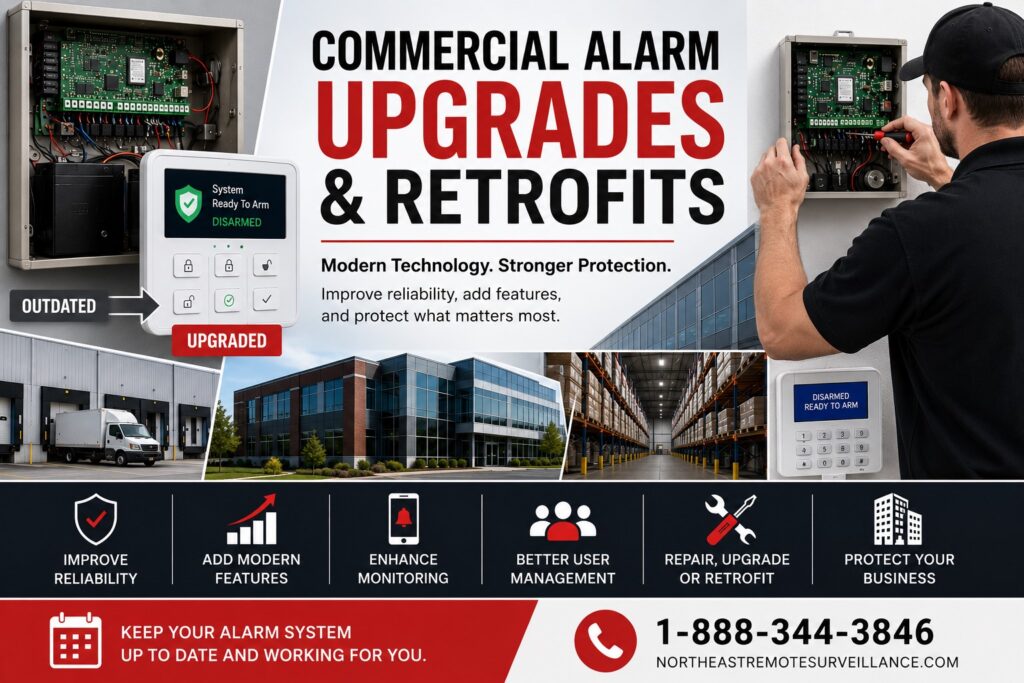
Commercial alarm systems do not always need to be completely replaced when they become outdated. In many facilities, existing wiring, door contacts, motion detectors, sirens, and other components may still be usable while older control equipment, communication paths, programming, or individual devices need to be modernized.
A properly planned commercial alarm system upgrade or retrofit can improve reliability, monitoring, user management, detection coverage, and future expansion while preserving useful infrastructure where appropriate.
This approach can be especially valuable for warehouses, manufacturing plants, offices, schools, healthcare facilities, municipal properties, retail buildings, and other commercial environments with existing intrusion alarm equipment.
What Is a Commercial Alarm System Upgrade?
An alarm system upgrade improves specific parts or capabilities of an existing intrusion system.
An upgrade may involve:
- Replacing an outdated alarm control panel
- Installing new keypads
- Adding cellular or IP communication
- Replacing failed sensors
- Adding wireless devices
- Improving door and opening protection
- Adding motion detection
- Adding glass break detection
- Adding panic or duress devices
- Expanding zone capacity
- Adding partitions
- Improving event reporting
- Updating monitoring
- Cleaning up user codes
- Correcting zone descriptions
The objective is to improve the existing system rather than automatically removing everything that is already installed.
What Is an Alarm System Retrofit?
A retrofit modernizes an existing alarm system while reusing appropriate components and infrastructure.
A commercial retrofit may retain:
- Existing security wiring
- Door contacts
- Motion detectors
- Glass break sensors
- Sirens
- Power wiring
- Device locations
- Existing conduit
- Other compatible field equipment
New equipment can then be incorporated where necessary.
This can reduce unnecessary demolition and make upgrading an occupied commercial property considerably easier.
When Should a Commercial Alarm System Be Upgraded?
Several conditions may indicate that an intrusion alarm system is ready for modernization.
Common examples include:
- The alarm panel is obsolete or unsupported.
- Replacement parts are difficult to obtain.
- Keypads are failing or difficult to use.
- The system still relies on traditional telephone lines.
- Wireless technology is outdated.
- Alarm zones are poorly labeled.
- Employees share user codes.
- The system lacks sufficient partitions.
- The facility has expanded.
- New doors or rooms have been added.
- False alarms have become frequent.
- Monitoring communication is unreliable.
- Existing equipment cannot support additional devices.
- Management needs better reporting.
- The original alarm installer is no longer available.
An assessment can help determine whether repair, expansion, retrofit, or replacement is the best approach.
Reusing Existing Alarm Wiring
One of the biggest advantages of a retrofit is the possibility of retaining existing alarm wiring.
Commercial buildings can contain hundreds or thousands of feet of security cable routed through ceilings, walls, conduit, warehouses, mechanical spaces, and finished areas.
Before reuse, wiring should be evaluated for:
- Continuity
- Shorts or grounds
- Physical damage
- Proper conductor count
- Appropriate cable type
- Labeling
- Termination quality
- End-of-line supervision
- Overall condition
Usable wiring can significantly simplify a modernization project.
Replacing the Alarm Control Panel
The control panel is often one of the most important components to consider during an upgrade.
An older panel may still function but limit what the business can do.
A modern commercial alarm panel may provide:
- More alarm zones
- More partitions
- Additional users
- Improved wireless support
- Cellular communication
- IP communication
- Dual-path communication
- Improved event history
- Better reporting
- Remote administration
- Easier system expansion
Replacing the panel does not automatically mean that every existing field device must also be replaced.
Updating Alarm Communication
Older commercial alarm systems frequently communicate through traditional telephone lines.
A modernization project may replace that communication path with:
- Cellular communication
- Internet or IP communication
- Dual-path cellular and IP communication
Communication upgrades can improve supervision and eliminate dependence on obsolete telephone infrastructure.
The alarm system should be fully tested on the new communication path before the old service is discontinued.
Upgrading Keypads and User Management
Older keypads can make otherwise functional alarm systems unnecessarily difficult to operate.
A keypad upgrade may provide clearer system status, easier zone identification, and better control over multiple protected areas.
User administration should also be reviewed.
Instead of several employees sharing one code, newer systems may support individual credentials that provide greater accountability.
Management can then better determine:
- Who armed the system
- Who disarmed it
- When activity occurred
- Which location or partition was affected
This can be especially valuable in larger commercial properties.
Adding Alarm Partitions
A partition allows different portions of a building to be armed independently.
This can be useful when:
- Offices close before warehouse operations.
- Manufacturing continues overnight.
- Separate departments work different schedules.
- Multiple tenants occupy the same building.
- Shipping employees arrive before administrative staff.
- Certain areas require continuous protection.
An upgrade can often reorganize an older alarm system so it better matches current business operations.
Upgrading Door and Opening Protection
Changes to a building can leave older alarm systems with protection gaps.
A retrofit may add or replace contacts on:
- Exterior doors
- Employee entrances
- Loading dock doors
- Overhead doors
- Roof hatches
- Restricted interior doors
- Gates
Existing contacts can often remain when they are properly installed, compatible, and reliable.
Improving Interior Motion Detection
Older motion detectors may no longer provide the best coverage for a facility.
Building layouts may also change over time.
A retrofit can evaluate:
- Detector location
- Coverage pattern
- Warehouse shelving
- New partitions
- Machinery
- HVAC conditions
- Ceiling height
- Interior travel paths
Existing detectors may be relocated or replaced, while additional devices can be installed where needed.
Adding Glass Break Detection
Commercial buildings with accessible glass areas may benefit from added glass break protection.
A retrofit can add detectors around:
- Storefront glass
- Ground-floor offices
- Glass entrance areas
- Display windows
- Vulnerable exterior windows
Glass break protection can complement existing door contacts and motion detection.
Adding Panic and Duress Protection
Alarm modernization can also include employee safety improvements.
Panic or duress devices may be added at:
- Reception desks
- Cash-handling locations
- Customer service counters
- Administrative offices
- Healthcare reception areas
- Security stations
Wireless devices can sometimes be added without disturbing existing alarm wiring.
Converting to a Hybrid Wired and Wireless System
A commercial retrofit does not have to remain entirely wired.
Modern hybrid systems can retain good hardwired devices while adding wireless equipment where new cabling would be difficult.
A hybrid upgrade might use:
Existing wired devices for original doors, motions, glass break detectors, and sirens.
New wireless devices for renovated offices, additional doors, remote areas, panic buttons, or difficult-to-wire locations.
This approach can provide an efficient migration path without wasting good infrastructure.
Upgrading Wireless Alarm Technology
Older wireless alarm systems may also benefit from modernization.
Current commercial platforms can provide features such as:
- Two-way communication
- Encryption
- Device supervision
- Low-battery reporting
- Improved range
- Signal-strength diagnostics
- Repeaters
- Improved battery management
The existing wireless platform should be evaluated before deciding whether devices can remain or require replacement.
Reducing False Alarms
An alarm retrofit is also an opportunity to correct recurring nuisance alarms.
Possible causes include:
- Aging contacts
- Poorly located motion detectors
- Loose wiring
- Failing batteries
- Damaged devices
- Improper programming
- Environmental conditions
- Poor zone descriptions
- Employee operating problems
Simply replacing the control panel without correcting these issues may leave the business with the same problems on newer equipment.
Alarm System Takeovers
Businesses frequently inherit alarm systems after:
- Purchasing a building
- Changing tenants
- Changing property managers
- Acquiring another company
- Ending a relationship with an existing alarm provider
A new provider may be able to evaluate and take over portions of the existing system.
Before accepting the equipment for continued service, the system should be reviewed for condition, ownership, programming access, compatibility, monitoring configuration, and long-term supportability.
Upgrade, Retrofit, or Complete Replacement?
Not every existing system should be preserved.
Complete replacement may make more sense when:
- The equipment is unsupported.
- Programming access cannot be obtained.
- Wiring is extensively damaged.
- The system is unreliable.
- Replacement components are unavailable.
- The platform cannot support the facility’s requirements.
- Security needs have changed substantially.
- Continuing repairs would cost more than modernization.
The correct decision should be based on long-term reliability rather than simply keeping old equipment because it is already installed.
Warehouses and Manufacturing Facilities
Alarm upgrades can be particularly valuable in warehouses and industrial buildings.
These properties often evolve over many years.
A retrofit may address:
- New loading doors
- Additional warehouse space
- Manufacturing expansions
- New offices
- Tool rooms
- Equipment rooms
- Restricted inventory
- Different operating shifts
- Added employee entrances
The alarm system should change as the facility changes.
Multi-Site Commercial Alarm Upgrades
Organizations with several properties may also use an upgrade project to standardize alarm systems across multiple locations.
Standardization can help provide:
- Consistent user management
- Similar keypad operation
- Common alarm reporting
- Standard zone naming
- Consistent monitoring procedures
- Easier employee training
- Simpler future service
Existing equipment does not necessarily need to be replaced simultaneously at every location.
A phased migration may be more practical.
Plan Before Replacing Equipment
A commercial alarm upgrade should begin with an assessment of what is already installed.
That assessment should consider:
- Alarm control equipment
- Keypads
- Door contacts
- Motion detectors
- Glass break sensors
- Panic devices
- Wireless devices
- Existing wiring
- Communication paths
- Monitoring
- User codes
- Alarm partitions
- Building changes
- Known service problems
- Future expansion
The goal is to determine what should remain, what should be repaired, what should be upgraded, and what should be replaced.
For broader planning involving aging, inherited, unsupported, or underperforming commercial security equipment, review Commercial Security System Upgrades, Retrofits & Takeovers from Northeast Remote Surveillance and Alarm.
Commercial and Industrial Applications
Alarm upgrades and retrofits can be performed in:
- Warehouses
- Manufacturing plants
- Distribution centers
- Offices
- Retail properties
- Schools
- Municipal facilities
- Healthcare properties
- Industrial buildings
- Multi-tenant properties
- Multi-building campuses
Every existing system starts from a different condition, which is why an assessment should come before equipment replacement.
Planning a Commercial Alarm Upgrade?
A properly planned retrofit can preserve useful wiring and equipment while correcting outdated panels, communication paths, detection gaps, user management, monitoring, and expansion limitations.
The objective is not to save every old component or replace everything automatically. It is to build a dependable commercial alarm system around the facility’s current needs while making sensible use of existing infrastructure.
I verified that the destination above is NERSA’s current sitewide Commercial Security System Upgrades, Retrofits & Takeovers resource; it explicitly covers intrusion-alarm panel replacement, partitions, zone cleanup, communicator replacement, retrofits, and system takeovers.