
Commercial Alarm Panel Communication Options
A commercial alarm system is only as useful as its ability to communicate an alarm condition to the people responsible for responding to it.
Door contacts, motion detectors, glass break sensors, and panic devices identify activity inside the building, but the alarm communicator provides the connection between the protected facility and the monitoring infrastructure.
Modern commercial alarm systems can communicate through Ethernet/IP, cellular networks, combinations of cellular and IP, private radio networks, and—in older installations—traditional telephone services.
Choosing the correct communication method is particularly important for warehouses, manufacturing facilities, offices, schools, healthcare properties, municipal buildings, retail facilities, and multi-site commercial operations.
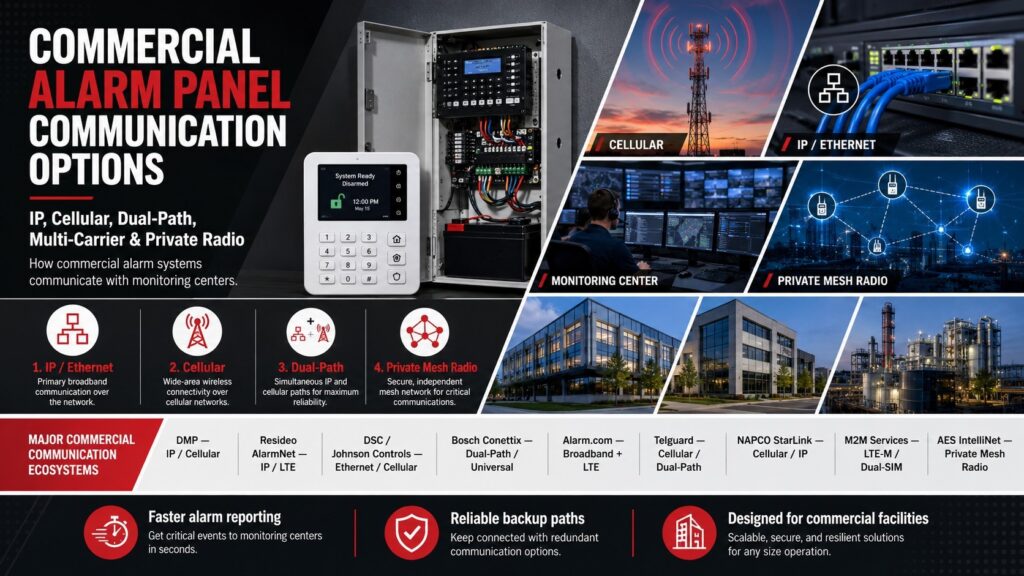
What Does an Alarm Communicator Do?
When the alarm control panel identifies an event, the communicator transmits information to a monitoring center or other receiving platform.
Depending on the system, transmitted events may include:
- Burglary alarms
- Panic and duress alarms
- Door alarms
- System troubles
- AC power failures
- Low batteries
- Communication failures
- Opening and closing activity
- Supervisory conditions
- Tamper events
Modern communicators can also support remote programming, system diagnostics, user applications, and other management functions depending on the alarm platform.
Traditional Telephone Line Communication
Older commercial alarm systems commonly used POTS—Plain Old Telephone Service.
The alarm panel dialed a monitoring-center receiver and transmitted an alarm format such as Contact ID.
Although enormous numbers of existing commercial systems were designed around telephone communication, businesses are increasingly moving away from traditional copper telephone infrastructure.
Many modern communicators can capture the reporting output from an older panel and retransmit it over cellular or IP networks. NAPCO, Resideo, Bosch, Telguard, and other manufacturers offer products intended to help modernize older dialer-based systems. (Napco Security Technologies)
Ethernet and IP Alarm Communication
An IP communicator uses the building’s network connection to transmit alarm information.
Advantages can include:
- Fast alarm transmission
- Supervised communications
- No dedicated telephone line
- Remote programming capabilities
- Integration with newer alarm platforms
The principal consideration is that the alarm system now depends to some extent on the property’s network infrastructure.
Routers, switches, internet service, network power, and configuration therefore become part of the communication path.
For many businesses, IP becomes substantially more resilient when paired with cellular backup.
Cellular Alarm Communication
Cellular communication has become one of the most common methods of replacing traditional alarm telephone lines.
The alarm communicator uses a cellular network to transmit events without depending on the property’s conventional internet service.
Current commercial communicator families include LTE and LTE-M technology, depending on the manufacturer and device. Telguard, NAPCO and M2M Services, for example, currently offer LTE-M-based commercial communication products. (Telguard)
Cellular communication can be used as:
- The primary reporting path
- A backup to Ethernet/IP
- Part of a dual-path configuration
- A replacement for an obsolete telephone connection
Dual-Path Cellular and IP Communication
For many commercial facilities, dual-path communication is one of the strongest configurations.
The alarm panel communicates using both the property’s network and a cellular connection.
If one path becomes unavailable, the other can continue providing a communication route, subject to the equipment configuration and monitoring arrangement.
This architecture is supported by numerous commercial platforms. DSC PowerSeries Pro can designate Ethernet or cellular as the primary path with the other as secondary. Resideo offers selectable IP-only, cellular-only, and IP-primary/cellular-backup configurations on applicable equipment. Bosch’s B465 is specifically designed as a universal dual-path communicator. (Johnson Controls Docs)
Dual-SIM Cellular Communication
A newer development is the use of multiple cellular carriers within one communicator.
Instead of depending entirely on one carrier, compatible devices can use multiple carrier networks.
Examples include current equipment from Alarm.com, NAPCO and M2M Services. Alarm.com’s commercial fire communicator includes dual-SIM capability; NAPCO’s StarLink Fire MAX2 can automatically select between AT&T and Verizon networks; and M2M offers dual-SIM communicators using AT&T and Verizon. (Alarm.com)
Carrier diversity can be particularly valuable at commercial locations where cellular coverage varies.
DMP Commercial Alarm Communications
Digital Monitoring Products offers integrated communication options throughout its commercial XR alarm platform.
The XR150 and XR550 families support commercial intrusion applications, with the XR550 also integrating intrusion, commercial fire, and access control capabilities. DMP documentation supports multiple communication paths and network communication options. (DMP)
DMP systems can be configured around:
- Network/IP communication
- Cellular communication
- Multiple communication paths
- Encrypted communication
DMP is particularly attractive where intrusion detection, access control, and other building security functions are being coordinated through the same commercial platform.
Honeywell Home / Resideo AlarmNet
Resideo’s VISTA family uses AlarmNet communications infrastructure.
Compatible VISTA systems can use Internet and LTE communicators, eliminating the need for a conventional telephone line in appropriate installations. The VISTA-21iPLTE, for example, incorporates Internet communication and supports an optional LTE radio. (Resideo)
Resideo also supports commercial VISTA platforms such as the VISTA-128BPT and VISTA-250BPT with compatible LTE communicators. (Resideo)
Options within the ecosystem include:
- Ethernet/IP
- LTE cellular
- IP plus cellular
- AlarmNet routing
- Retrofit communicators for existing installations
This can make Resideo communications useful for both new VISTA installations and upgrades of a large existing installed base.
DSC / Johnson Controls Communications
DSC PowerSeries Pro is designed specifically for scalable commercial intrusion applications and supports Ethernet/IP and cellular communications. (Johnson Controls Docs)
Compatible configurations can use:
- Ethernet as primary
- Cellular as backup
- Cellular as primary
- Ethernet as backup
DSC allows the primary communication path to be selected through communicator programming. (Johnson Controls Docs)
This gives commercial installers flexibility when designing communications around the customer’s network and available cellular coverage.
Bosch Conettix Communications
Bosch offers Conettix communication equipment for its commercial security ecosystem.
The Bosch B465 Universal Dual Path Communicator can take reporting from a panel’s PSTN dialer interface and send the information through IP-based communication paths. (Bosch Security)
This approach can be useful when modernizing existing commercial panels because compatible legacy reporting can potentially be transitioned away from traditional telephone infrastructure without immediately replacing the entire alarm system.
Alarm.com Commercial Communication
Alarm.com provides cellular and broadband communication infrastructure that can connect compatible alarm systems to its cloud platform.
Alarm.com expanded its commercial fire offering in 2026 with a communicator using broadband plus 4G LTE dual-path communication and dual-SIM carrier capability. (Alarm.com)
Alarm.com is also widely used as an interactive-services platform alongside compatible intrusion control equipment, providing remote management and alarm-related services depending on the panel and service package.
Telguard
Telguard specializes in cellular alarm communications and offers universal communicator products for intrusion and commercial fire applications.
Current Telguard commercial products include:
- Cellular communication
- 5G LTE-M connectivity
- Internet plus cellular dual path
- Universal alarm-panel compatibility
Telguard’s commercial intrusion portfolio includes LTE-M and dual-path products, while its commercial fire line includes sole-path and dual-path options. (Telguard)
Universal communicators can be especially useful when an existing alarm control panel remains functional but its original communication method has become obsolete.
NAPCO StarLink
NAPCO’s StarLink family provides cellular and IP communication products for intrusion and commercial fire applications.
Current StarLink offerings include:
- Cellular alarm reporting
- IP reporting
- Cellular/IP dual-path configurations
- LTE-M products
- Dual-SIM capabilities on selected equipment
- Universal communicator models
NAPCO specifically positions StarLink as a way of migrating aging systems away from disappearing copper telephone lines. (Napco Security Technologies)
Some universal StarLink intrusion communicators can work with alarm panels from other manufacturers using established reporting formats. (Napco Security Technologies)
M2M Services
M2M Services is another manufacturer of universal alarm communications equipment.
Its current commercial offerings include LTE-M, dual-SIM and dual-path communication, with products capable of using AT&T and Verizon cellular connectivity. (M2M Services)
M2M equipment can be useful for alarm-system takeovers and communication upgrades because selected devices support several established alarm-panel families. (M2M Services)
AES Private Mesh Radio
AES takes a fundamentally different approach from cellular and internet communication.
AES IntelliNet uses a privately operated wireless mesh radio network designed specifically for alarm communications.
Rather than relying on a public cellular carrier or the customer’s Internet service, alarm subscribers communicate through a mesh of radio devices that can route alarm traffic through the private network. AES describes its mesh technology as self-healing and designed without a single communication path becoming the sole point of failure. (AES Corporation)
AES equipment is available for:
- Commercial burglary
- Commercial fire
- Facility monitoring
Private radio networks can be particularly attractive to monitoring organizations and commercial environments where independence from public telecommunications infrastructure is desirable.
Universal Communicator vs. Panel-Native Communication
Commercial alarm communication equipment generally falls into two categories.
Panel-native communication is specifically designed to work with the alarm manufacturer’s control equipment. Examples include DMP communications, Resideo AlarmNet modules, DSC communicators, and Bosch Conettix equipment.
Advantages may include deeper diagnostics, remote programming, system status information, and tighter integration.
Universal communicators are designed to work with multiple alarm-panel brands.
Telguard, StarLink, M2M, Bosch’s B465 in applicable applications, and similar products can be valuable when upgrading an older system without replacing the existing control panel.
Which Communication Method Is Best?
There is no single answer for every commercial property.
A small office may operate successfully with cellular communication.
A warehouse may benefit from Ethernet plus cellular backup.
A multi-site organization may prefer standardized dual-path communication across every facility.
A high-security operation may consider multiple independent communication technologies.
An existing building with a reliable legacy panel may only require a universal communicator retrofit.
Factors to consider include:
- Available internet service
- Cellular signal strength
- Carrier availability
- Existing alarm panel
- Monitoring-center compatibility
- Required supervision
- Building use
- System listing requirements
- Backup power
- Desired redundancy
- Remote management requirements
- Future expansion
Communication Should Be Part of the Alarm Design
Replacing an obsolete telephone line with a cellular radio is sometimes straightforward, but commercial alarm communication should still be treated as part of the overall security-system design.
The installer should evaluate the control panel, reporting format, available communication paths, network infrastructure, cellular coverage, backup power, monitoring center, and the consequences of losing a communication path.
For additional information about intrusion detection, monitoring, system communication and commercial facility protection, visit Northeast Remote Surveillance and Alarm’s commercial alarm system installation guide.
Planning Commercial Alarm Communications?
Modern commercial alarm systems can communicate through IP, cellular, dual-path cellular/IP, multi-carrier cellular, or private mesh radio networks.
The correct solution may involve equipment from DMP, Honeywell Home/Resideo, DSC/Johnson Controls, Bosch, Alarm.com, Telguard, NAPCO StarLink, M2M Services, AES, or another compatible commercial platform.
Rather than selecting a communicator solely by price or carrier, the communication architecture should be designed around the alarm panel, facility, monitoring requirements, available infrastructure, and amount of redundancy the business requires.
This covers the major commercial panel-native and universal communicator ecosystems currently active in North America.