
Commercial Panic and Duress Alarm Systems
Commercial panic and duress alarm systems provide employees with a fast way to request assistance during threatening, dangerous, or emergency situations.
Unlike intrusion detection, which is primarily designed to identify unauthorized entry when a building or area is secured, panic and duress devices are intended to allow a person to manually initiate an alarm when immediate help may be needed.
These systems can be used in offices, retail locations, schools, municipal buildings, healthcare facilities, warehouses, financial offices, reception areas, and other commercial environments where employee safety is a concern.
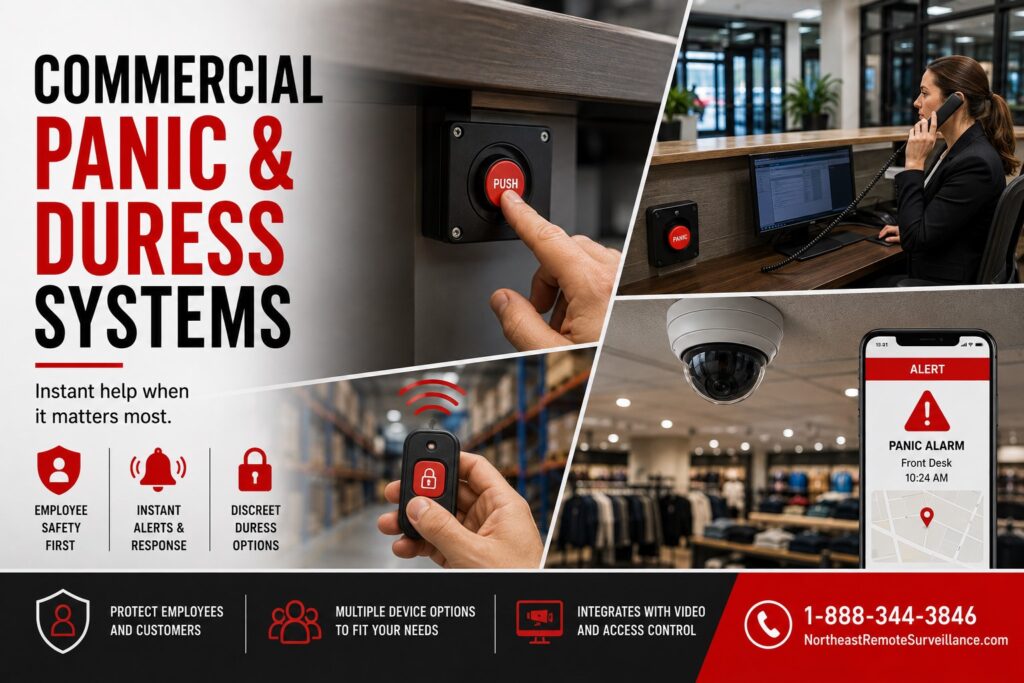
What Is a Commercial Panic Alarm?
A commercial panic alarm is a manually activated security device connected to an alarm system.
Depending on the system design, pressing the device can generate a local or remotely monitored alarm.
Common devices may include:
- Fixed panic buttons
- Under-counter buttons
- Desk-mounted panic devices
- Wall-mounted emergency buttons
- Wireless panic transmitters
- Portable panic devices
- Keypad panic functions
- Specialized duress switches
The correct device depends on the application, employee workflow, and type of response required.
What Is a Duress Alarm?
A duress alarm is designed for situations where an employee may need to request assistance without drawing attention to the activation.
This can be useful where openly calling for help could increase the risk to the person involved.
Possible applications include:
- Reception desks
- Cash-handling locations
- Medical offices
- Public service counters
- Administrative offices
- Financial institutions
- Secure facilities
- Municipal buildings
Duress devices may be configured differently from conventional audible panic alarms depending on the intended response.
Fixed Panic Buttons
Fixed panic buttons are permanently installed in a location where employees can reach them quickly.
Common locations include:
- Under desks
- Under counters
- Reception stations
- Cash registers
- Security desks
- Administrative workstations
- Customer service counters
A fixed device has the advantage of always being in a known location.
Placement should make the device easy for authorized employees to reach while reducing the possibility of accidental activation.
Wireless Panic Devices
Wireless panic devices can provide additional flexibility where installing cabling is difficult or employees require greater mobility.
They may be used in:
- Large offices
- Warehouses
- Healthcare facilities
- Schools
- Retail spaces
- Multi-room commercial properties
Wireless devices should be selected for reliable communication throughout the protected area and should be supervised according to the capabilities of the alarm system.
Battery maintenance and device testing should also be part of the system’s ongoing service plan.
Silent and Audible Panic Alarms
Panic alarms can be configured differently depending on the application.
An audible panic alarm may activate sirens or other local notification devices.
A silent duress alarm may transmit an event without producing an obvious local indication.
The correct approach depends on the property’s security procedures and desired response.
For example, an employee facing a threatening person at a counter may need a discreet method of requesting assistance, while another type of emergency may benefit from immediate local notification.
Reception and Front Desk Protection
Reception and front desk areas are often the first point of interaction between employees and visitors.
These locations may benefit from panic or duress protection because employees can encounter unexpected or escalating situations.
A properly positioned device can provide a direct method of requesting assistance without requiring an employee to leave the workstation or search for a phone.
Panic protection can also be coordinated with:
- Access control
- Video surveillance
- Intercom systems
- Door locking systems
- Intrusion alarms
- Remote monitoring
Retail and Cash-Handling Applications
Retail facilities, customer service counters, and cash-handling environments can have increased exposure to robbery or threatening behavior.
Panic devices may be installed near:
- Registers
- Manager offices
- Service desks
- Cash rooms
- Secure storage areas
The system design should take into account who has access to the device, how employees are trained to use it, and what type of response should occur after activation.
Schools and Educational Facilities
Educational properties may use panic or duress devices in selected areas as part of a broader emergency communication and security strategy.
Potential locations include:
- Administrative offices
- Reception areas
- Main entrances
- Security offices
- Nurse stations
- Other designated staff locations
Panic devices should be integrated into established emergency procedures rather than treated as a standalone solution.
Healthcare Facilities
Healthcare environments can present unique employee safety concerns because staff may interact with patients, visitors, and members of the public under stressful circumstances.
Duress protection may be considered for:
- Reception desks
- Behavioral health areas
- Administrative offices
- Pharmacy areas
- Billing offices
- Treatment areas where appropriate
System design should account for the physical environment and the facility’s established emergency response procedures.
Panic Devices and Video Surveillance
Video surveillance can provide additional information when a panic or duress alarm is activated.
Where systems are integrated, an alarm event may help security personnel or management quickly identify cameras covering the affected area.
This can support:
- Event verification
- Incident review
- Situational awareness
- Investigation
- Remote response
Video surveillance does not replace a panic device, but the two systems can work together as part of a broader security strategy.
Panic Alarms and Access Control
Panic and duress systems may also be coordinated with access control.
Depending on the application and system design, an emergency event may be associated with controlled doors, employee entrances, reception areas, or restricted zones.
The exact response should be carefully planned so that security actions do not conflict with life-safety or emergency egress requirements.
Monitoring Panic and Duress Events
A panic or duress alarm can be programmed to transmit an event to a monitoring center according to the system’s design and service arrangement.
Because these alarms can represent situations involving immediate personal safety, system configuration, testing, employee training, and response procedures are especially important.
The monitoring response should be established in advance so employees understand what happens after a device is activated.
Reducing Accidental Activations
Panic devices need to be readily accessible without being easily triggered by accident.
Good system design considers:
- Button location
- Device type
- Protective covers where appropriate
- Employee movement
- Furniture placement
- Workstation layout
- Training
- Testing procedures
Devices should also be clearly identified to authorized personnel who may need to use them.
Employee Training
Technology alone does not create an effective duress plan.
Employees should understand:
- Where panic devices are located
- When they should be used
- How the device is activated
- Whether the alarm is silent or audible
- What response is expected
- Who should be notified internally
- How accidental activations are handled
Training should be consistent with the organization’s broader emergency response procedures.
Planning Commercial Panic and Duress Protection
Before selecting panic devices, businesses should consider:
- Which employees interact with the public?
- Are cash or valuables handled onsite?
- Are employees ever isolated?
- Which workstations have higher risk?
- Should devices be fixed or portable?
- Is discreet activation required?
- Should video surveillance cover the area?
- Is professional alarm monitoring required?
- What response should occur after activation?
- How will employees be trained?
These questions help determine the appropriate device type, placement, and system configuration.
Part of a Layered Commercial Alarm System
Panic and duress protection works best as part of a broader commercial security strategy.
A complete intrusion and emergency protection system may include:
- Door and opening contacts
- Interior motion detection
- Glass break detection
- Panic and duress devices
- Perimeter sensors
- Alarm monitoring
- Video surveillance integration
Each technology addresses a different type of risk.
Businesses evaluating these options can learn more about commercial alarm system installation from Northeast Remote Surveillance and Alarm.
Commercial and Industrial Applications
Panic and duress systems can be designed for many types of commercial properties, including:
- Offices
- Retail stores
- Schools
- Healthcare facilities
- Municipal buildings
- Warehouses
- Manufacturing facilities
- Financial offices
- Customer service centers
- Multi-building campuses
The system should be designed around the people, facility layout, operating procedures, and expected emergency response.
Planning Panic and Duress Protection?
A professional security assessment can help identify higher-risk employee locations, determine appropriate device types, evaluate monitoring requirements, and coordinate panic protection with existing intrusion, access control, and video surveillance systems.
For more information about commercial intrusion protection and monitored alarm systems, visit Northeast Remote Surveillance and Alarm’s guide to commercial alarm system installation.