
Commercial Wired Alarm Systems
Commercial wired alarm systems remain a strong choice for businesses that want reliable intrusion detection using hardwired sensors, control panels, keypads, and communication equipment.
In warehouses, manufacturing plants, offices, retail facilities, schools, municipal buildings, healthcare properties, and other commercial environments, a properly installed wired system can provide dependable protection for doors, windows, interior areas, and specialized openings.
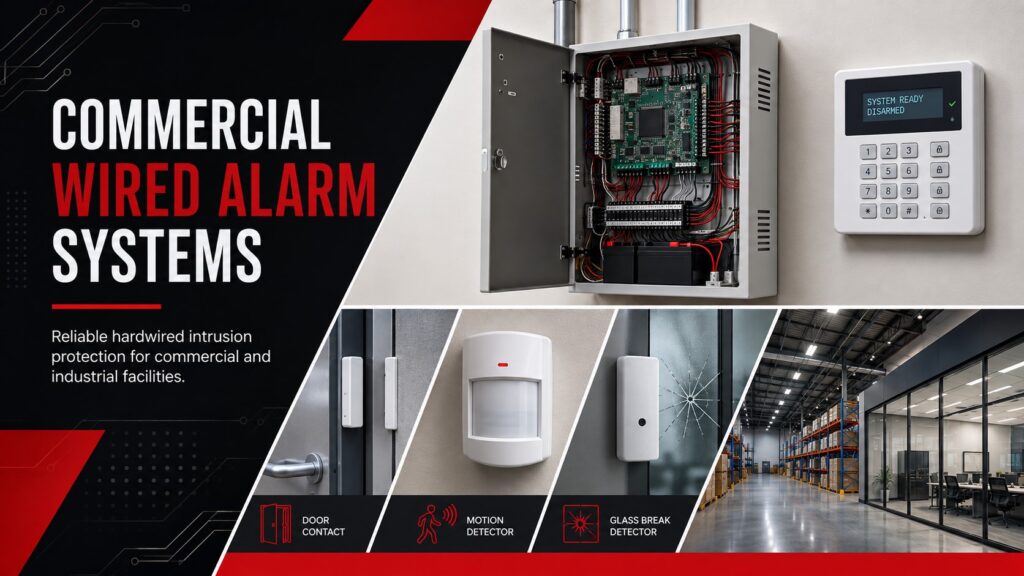
What Is a Wired Alarm System?
A wired alarm system uses physical cabling to connect security devices back to an alarm control panel.
Common hardwired devices include:
- Door contacts
- Window contacts
- Motion detectors
- Glass break detectors
- Panic and duress buttons
- Overhead door contacts
- Heat or environmental sensors
- Keypads
- Sirens
- Communication modules
Each device communicates with the control panel through dedicated wiring rather than relying entirely on wireless radio signals.
Why Businesses Use Wired Alarm Systems
Wired alarm systems are commonly selected because they can provide stable communication between field devices and the main control equipment.
They are especially well suited for:
- New construction
- Major renovations
- Large commercial buildings
- Warehouses
- Manufacturing facilities
- Multi-zone properties
- Facilities with existing alarm wiring
- Buildings where long-term system stability is important
When cabling is installed correctly and protected from damage, hardwired systems can provide years of dependable operation.
Wired Door and Opening Protection
Door and opening contacts are one of the most common hardwired alarm devices.
They can be installed on:
- Exterior doors
- Employee entrances
- Emergency exits
- Loading dock doors
- Overhead doors
- Roof hatches
- Interior restricted-area doors
- Exterior gates
Hardwired contacts can be especially useful where devices are permanently installed and frequent battery replacement is undesirable.
Wired Motion Detection
Commercial motion detectors can also be connected directly to the alarm panel.
Hardwired motion detectors are often used in:
- Hallways
- Offices
- Warehouses
- Stockrooms
- Manufacturing areas
- Equipment rooms
- Retail spaces
These devices provide interior protection and can supplement perimeter door and window contacts.
Wired Glass Break Detection
Glass break detectors can also be installed as part of a wired intrusion system.
These devices may be used around:
- Storefront glass
- Office windows
- Glass entry doors
- Ground-floor windows
- Display areas
Hardwired glass break detection can provide an additional layer of perimeter protection when vulnerable glass areas are present.
Panic and Duress Devices
Fixed panic and duress buttons are often installed using dedicated wiring.
These devices may be placed at:
- Reception desks
- Cash-handling stations
- Customer service counters
- Security offices
- Administrative workstations
- Healthcare reception areas
Hardwired panic devices can provide a permanent, supervised connection to the alarm control system.
Wired Alarm Panels
The control panel is the central component of the system.
It receives signals from connected devices and determines how the system should respond.
A commercial panel may support:
- Multiple alarm zones
- Multiple keypads
- Separate partitions
- User codes
- Event history
- Alarm monitoring
- Remote communication
- Integration with other systems
Larger facilities may require expandable panels capable of supporting many zones and multiple areas.
Alarm Zones
Each device or group of devices is assigned to an alarm zone.
Zones help identify where an event occurred.
Examples may include:
- Front entrance
- Rear warehouse door
- Loading dock
- Office motion detector
- Glass break zone
- Server room
- Shipping area
- Panic button
Good zone labeling makes the system easier to operate, troubleshoot, and monitor.
Supervised Wiring
Commercial alarm wiring is typically supervised so the system can identify certain wiring problems.
Depending on the system design, supervision can help detect conditions such as:
- Open circuits
- Short circuits
- Cut wiring
- Device faults
End-of-line resistors may be used to help the control panel distinguish normal conditions from wiring trouble or alarm events.
Proper resistor placement and circuit design are important for reliable supervision.
Wired vs. Wireless Alarm Systems
Both wired and wireless systems can be appropriate in commercial applications.
Wired systems are often preferred when:
- Cabling is already available
- The building is under construction
- Devices are permanently located
- Long-term stability is a priority
- Battery maintenance should be minimized
Wireless systems may be useful where running new cable would be difficult or disruptive.
Many modern commercial systems use a hybrid design that combines wired and wireless devices.
Hybrid Alarm Systems
A hybrid alarm system allows a business to use existing hardwired devices while adding wireless equipment where needed.
This can be useful during system upgrades.
For example, a facility may retain existing door contacts and motion detectors while adding:
- Wireless panic buttons
- Additional wireless contacts
- Remote keypads
- New expansion devices
Hybrid systems can make it easier to modernize an existing building without replacing every device.
Existing Alarm Wiring
Commercial buildings often contain alarm wiring from previous systems.
In some cases, this wiring can be reused during an upgrade or system replacement.
Before reuse, existing cabling should be evaluated for:
- Physical condition
- Proper labeling
- Continuity
- Shorts or grounds
- Correct conductor count
- Appropriate routing
- Compatibility with the new system
Reusing good wiring can reduce disruption and installation cost.
New Construction and Renovation
New construction is an ideal time to install alarm wiring.
Cables can be routed before walls and ceilings are finished, allowing sensors to be placed where they provide the best coverage.
Planning early can also make provisions for:
- Door contacts
- Motion detectors
- Glass break detectors
- Panic devices
- Keypads
- Sirens
- Communication equipment
- Future expansion
Proper prewiring can make future upgrades easier.
Warehouses and Industrial Facilities
Wired systems are particularly common in warehouses and industrial properties.
These buildings may require protection for:
- Large numbers of doors
- Overhead doors
- Shipping areas
- Offices
- Equipment rooms
- Interior motion zones
- High-value storage areas
Hardwired systems can provide a centralized and structured approach to protecting large facilities.
Alarm Monitoring
A wired alarm system can communicate with a monitoring center using modern communication technology.
Depending on the system, communication may use:
- Cellular
- Internet
- Dual-path communication
- Other supported communication methods
The detection devices may be hardwired even though the system uses modern network or cellular communication for alarm reporting.
Businesses evaluating these systems can learn more about commercial alarm system installation from Northeast Remote Surveillance and Alarm.
Maintenance of Wired Alarm Systems
Wired alarm systems still require periodic inspection and testing.
Maintenance may include:
- Testing door contacts
- Testing motion detectors
- Testing panic devices
- Inspecting wiring
- Checking backup batteries
- Reviewing communication paths
- Verifying alarm monitoring
- Testing sirens and notification devices
Routine service can help identify problems before they affect system performance.
Planning a Commercial Wired Alarm System
Before installing or upgrading a wired alarm system, consider:
- How many doors and openings require protection?
- Are existing wires available?
- Is the building under construction or already occupied?
- Are there overhead doors or gates?
- Are interior motion detectors required?
- Are panic or duress devices needed?
- Should the system be divided into separate areas?
- Will existing devices be reused?
- Is professional monitoring required?
- Should wireless devices be added in difficult locations?
These questions help determine the correct panel, device count, wiring requirements, and system configuration.
Commercial and Industrial Applications
Wired alarm systems can be used in many types of facilities, including:
- Warehouses
- Manufacturing plants
- Distribution centers
- Offices
- Retail properties
- Schools
- Municipal buildings
- Healthcare facilities
- Storage facilities
- Multi-building campuses
The best design depends on the size of the property, existing infrastructure, operating requirements, and security risks.
Planning a Commercial Alarm System?
A professional security assessment can evaluate existing wiring, alarm devices, vulnerable openings, interior protection needs, and monitoring requirements to determine whether a wired, wireless, or hybrid system is the best fit.
For more information about commercial intrusion detection and monitored alarm systems, visit Northeast Remote Surveillance and Alarm’s guide to commercial alarm system installation.