
Hybrid Wired and Wireless Commercial Alarm Systems
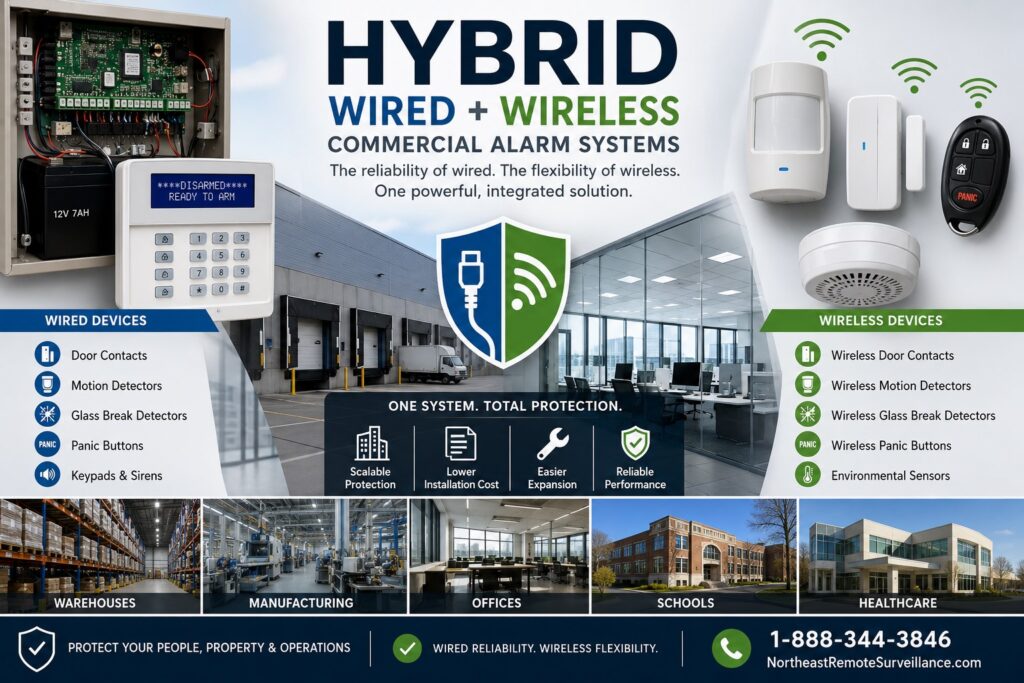
Hybrid wired and wireless commercial alarm systems combine the reliability of hardwired security devices with the installation flexibility of modern wireless technology.
For many commercial and industrial properties, this approach provides the best balance between dependable existing infrastructure and easier expansion. A facility can continue using hardwired door contacts, motion detectors, keypads, and other devices while adding wireless protection in areas where running new cable would be difficult, disruptive, or expensive.
Hybrid systems are especially useful for warehouses, manufacturing facilities, offices, schools, municipal buildings, healthcare properties, retail locations, and multi-building commercial sites.
What Is a Hybrid Commercial Alarm System?
A hybrid alarm system supports both hardwired and wireless security devices on the same intrusion alarm platform.
The system may include:
- Hardwired door contacts
- Hardwired motion detectors
- Wired glass break detectors
- Wired panic and duress devices
- Wireless door contacts
- Wireless motion detectors
- Wireless glass break detectors
- Wireless panic buttons
- Wireless specialty sensors
- Wired or wireless keypads
- Alarm communicators
- Expansion modules
The control panel coordinates all of these devices as part of one commercial intrusion detection system.
Why Commercial Buildings Use Hybrid Alarm Systems
Many existing commercial properties already contain usable security wiring.
Completely replacing that wiring with wireless equipment may not provide any meaningful advantage. At the same time, extending new cable into every renovated office, remote warehouse door, or finished space may be unnecessarily expensive.
A hybrid system allows the installer to use the best method for each part of the building.
For example:
- Existing hardwired contacts can remain in service.
- New wireless sensors can be added to renovated areas.
- Difficult-to-reach doors can be protected wirelessly.
- Fixed panic devices can remain wired.
- Portable duress devices can be added wirelessly.
- Warehouse expansion areas can be added without major cabling work.
This flexibility is one of the strongest advantages of hybrid alarm design.
Reusing Existing Alarm Wiring
Commercial buildings often have wiring left from an older intrusion alarm system.
If that cabling is in good condition, it may be possible to reuse it when upgrading the alarm panel.
Existing wiring should be evaluated for:
- Continuity
- Shorts and grounds
- Physical condition
- Correct conductor count
- Proper labeling
- Routing
- End-of-line supervision
- Compatibility with the new equipment
Good existing wiring can provide a solid foundation for a modern hybrid system.
Hardwired Devices in a Hybrid System
Hardwired devices remain an excellent choice for permanent locations.
Common examples include:
- Exterior door contacts
- Warehouse overhead door contacts
- Interior motion detectors
- Glass break detectors
- Fixed panic buttons
- Keypads
- Sirens
- High-value room protection
Hardwired devices do not normally require individual wireless batteries and can provide long-term stability when installed correctly.
Wireless Devices in a Hybrid System
Wireless devices can be added where installing new wire is impractical.
Common applications include:
- Finished offices
- Remote doors
- Detached storage areas
- Renovated spaces
- Temporary interior partitions
- Additional warehouse protection
- Wireless panic buttons
- Areas with difficult cable pathways
Modern commercial wireless platforms can provide supervision, low-battery reporting, encrypted communications, and strong diagnostic capabilities.
Expanding Existing Commercial Alarm Systems
Hybrid technology can be particularly valuable when a business expands.
Consider a warehouse that originally has a fully wired alarm system. Years later, the company adds:
- A new office
- Additional shipping doors
- A mezzanine
- A remote storage area
- New employee entrances
Instead of rewiring the entire property, the original hardwired protection can remain while wireless devices are added to the new areas.
This allows the security system to grow with the facility.
Hybrid Systems for Renovations
Renovations often create a strong case for hybrid alarm design.
Running new security wire through completed walls, ceilings, decorative finishes, or occupied workspaces can add unnecessary labor and disruption.
Wireless devices can often be used in renovated portions of the building while the original wired infrastructure continues operating elsewhere.
This approach can reduce:
- Wall damage
- Ceiling disruption
- Installation time
- Business interruption
- Cabling labor
The goal is not to make every device wireless. It is to use wireless technology where it provides a practical advantage.
Warehouse and Industrial Applications
Warehouses and manufacturing facilities are especially well suited for hybrid alarm systems.
These buildings often have existing hardwired devices in the original structure but may later add new loading areas, offices, storage spaces, or equipment rooms.
A hybrid system may use hardwired protection for:
- Main exterior doors
- Original warehouse motion detectors
- Existing glass break sensors
- Control rooms
- Fixed keypads
Wireless devices can then be used for:
- Remote overhead doors
- New office areas
- Added storage rooms
- Portable panic devices
- Difficult-to-wire sections
This creates a system that can adapt to changing building layouts.
Hybrid Panic and Duress Protection
Panic and duress systems can also benefit from hybrid technology.
A facility may use hardwired buttons at permanent locations such as:
- Reception desks
- Cash-handling stations
- Security desks
- Customer service counters
Wireless panic devices can then be added for employees who need more mobility.
This can be useful in:
- Schools
- Healthcare facilities
- Warehouses
- Retail environments
- Municipal properties
- Large offices
The combination provides both fixed and portable emergency activation options.
Hybrid Motion Detection
Interior protection can also use a mix of wired and wireless motion detectors.
Existing hardwired motion sensors may continue protecting hallways, warehouses, and offices while wireless detectors are added to new or renovated spaces.
This is especially useful where a building’s interior layout changes over time.
Hybrid Glass Break Detection
Glass break sensors can also be added using either wired or wireless technology.
A building may already have hardwired glass break protection in its original office section but require additional protection around:
- New storefront glass
- Renovated entrances
- Added conference rooms
- New exterior windows
Wireless detectors can make these additions easier without disturbing completed construction.
Alarm Panel Expansion
A hybrid commercial alarm panel may use several types of expansion equipment.
Depending on the manufacturer, these can include:
- Wired zone expanders
- Wireless receivers
- Wireless transceivers
- Repeaters
- Remote power supplies
- Additional keypads
- Communication modules
System capacity should be planned around both current protection needs and future growth.
Wireless Supervision
Commercial wireless devices should be supervised by the alarm system.
Supervision allows the panel to identify problems such as:
- Missing wireless devices
- Low batteries
- Tamper conditions
- Communication failures
This is one reason professional commercial wireless equipment should not be confused with simple consumer-grade wireless sensors.
Signal Testing Is Important
Wireless devices must be tested at their actual installation locations.
Commercial buildings may contain materials that affect radio signals, including:
- Structural steel
- Concrete block
- Reinforced concrete
- Metal siding
- Insulated panels
- Warehouse shelving
- Machinery
- Elevators
- Stored inventory
A hybrid system should be designed around actual building conditions rather than assumptions about wireless range.
Wired vs. Wireless Is Not an Either-Or Decision
Commercial security planning is sometimes framed as a choice between wired and wireless.
In practice, many facilities are better served by using both.
Hardwired devices can provide reliable protection where cable already exists or is easy to install.
Wireless devices can solve installation challenges and simplify future expansion.
The hybrid approach allows each technology to be used where it makes the most sense.
Upgrading Legacy Alarm Systems
Hybrid systems can also be useful when replacing older commercial alarm panels.
An upgrade may allow a business to retain compatible existing field wiring while adding:
- Modern wireless devices
- New communication technology
- Remote user management
- Cellular or internet monitoring
- Additional partitions
- Improved diagnostics
This can modernize the alarm system without requiring a complete replacement of every sensor in the building.
Alarm Monitoring
Hybrid systems can use modern monitoring communication regardless of whether individual detection devices are wired or wireless.
Depending on the system, alarm reporting may use:
- Cellular communication
- Internet communication
- Dual-path communication
- Other supported methods
The detection method inside the building is separate from the communication path used to transmit alarm events.
Businesses evaluating these systems can learn more about commercial alarm system installation from Northeast Remote Surveillance and Alarm.
Planning a Hybrid Commercial Alarm System
Before designing a hybrid alarm system, consider:
- What existing wiring can be reused?
- Which devices should remain hardwired?
- Which areas are difficult to cable?
- Is the facility likely to expand?
- Are wireless panic devices needed?
- Are there detached or remote areas?
- Does the building contain heavy steel or concrete construction?
- How many zones and partitions are required?
- Is professional monitoring required?
- Should the system support future wireless expansion?
These questions help determine the correct balance between wired and wireless protection.
Commercial and Industrial Applications
Hybrid alarm systems can be used in:
- Warehouses
- Manufacturing facilities
- Distribution centers
- Offices
- Schools
- Municipal buildings
- Retail properties
- Healthcare facilities
- Storage buildings
- Multi-building campuses
The strongest design is based on the building, existing infrastructure, operating needs, and future expansion plans.
Planning a Commercial Alarm Upgrade?
A professional security assessment can evaluate existing wiring, current alarm devices, wireless signal conditions, building construction, and expansion requirements to determine where wired and wireless technologies should be used.
For more information about commercial intrusion detection, monitoring, and alarm system upgrades, visit Northeast Remote Surveillance and Alarm’s guide to commercial alarm system installation.