
Monitored Alarm Video Verification
Commercial alarm monitoring becomes more useful when an alarm event can be supported by video.
Professional monitoring services may offer video verification alongside intrusion alarms. Check the supervising station’s current capabilities, event workflow, data-access permissions and service agreement; manufacturer and provider documentation, not a brand name, determines supported functions.
commercial security monitoring and response reference can design commercial security systems that combine intrusion detection, video surveillance, alarm communication, and professional monitoring so that selected alarm events can be reviewed with associated video when compatible equipment and services are used.
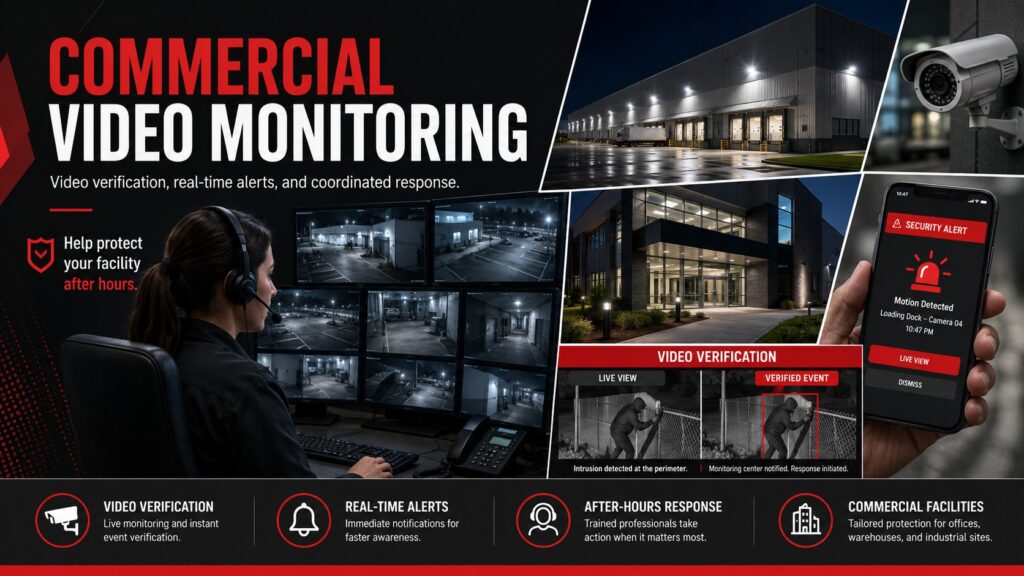
What Is Video Verification?
Video verification connects an alarm event with camera information from the protected property.
Instead of receiving only an alarm signal such as:
- Front door alarm
- Warehouse motion
- Glass break activation
- Perimeter alarm
- Loading dock intrusion
a compatible system can also provide associated video information that helps determine what may be occurring at the site.
COPS has offered event-driven video verification that allows monitoring operators to review video during the dispatch process. The additional visual information can help operators, customers, and responding authorities make more informed decisions. (Cops Monitoring)
NERSA Designs the Security System
The monitoring center is only one part of the overall solution.
NERSA evaluates the commercial property and designs the equipment that generates and supports the monitored events.
A video-verified commercial alarm system may include:
- Commercial intrusion alarm panel
- Door and opening contacts
- Motion detectors
- Glass break detection
- Panic or duress devices
- Commercial security cameras
- Network or recording equipment
- Alarm communication equipment
- Cellular or IP communication
- Professional monitoring
- Site-specific event instructions
The objective is to create a coordinated system rather than treating cameras and intrusion detection as unrelated technologies.
COPS Monitoring and NERSA
For the customer, NERSA remains the security-system provider and service relationship.
NERSA can design, install, configure, service, and support the commercial security equipment while professional monitoring functions are handled through the monitoring infrastructure associated with the account.
COPS describes itself as a wholesale professional monitoring company serving independent alarm dealers and providing monitoring across popular communication formats including IP, radio, wireless, and traditional dial-up technologies. (Cops Monitoring)
This arrangement allows NERSA to provide the customer-facing security solution while using dedicated monitoring-center resources for event response.
How Commercial Video Verification Works
The exact workflow depends on the equipment and monitoring service selected, but a typical event may follow this general sequence:
- A protected alarm device detects activity.
- The alarm panel generates an event.
- The event is transmitted to the monitoring infrastructure.
- Associated cameras or event clips may become available for review.
- The event is evaluated according to programmed procedures.
- Appropriate contacts or emergency responders may be notified according to the account instructions.
The goal is to provide more context around an alarm event before or during the response process.
Why Video Verification Matters
Traditional intrusion monitoring can tell an operator that a device has activated.
Video can potentially provide additional context.
For example, a warehouse motion detector might be activated by:
- An unauthorized person
- An employee who entered unexpectedly
- Maintenance activity
- An environmental condition
- Another source of movement
Associated video may help clarify what occurred.
COPS has specifically promoted video verification as a way to provide dispatch operators and law enforcement with additional information and to reduce unnecessary dispatches. (Cops Monitoring)
Event-Driven Video
Video verification is different from simply having remote camera access.
A conventional surveillance system records video that someone can review later.
An event-driven monitored system associates video with a security event so operators can focus on the cameras and time period that matter.
Potential triggers can include:
- Perimeter intrusion
- Interior motion
- Door activation
- After-hours activity
- Certain analytic events
- Other compatible alarm conditions
This makes cameras part of the response process rather than only an investigative tool.
Video Verification for Warehouses
Warehouses are especially well suited for alarm verification because they frequently have:
- Large interior spaces
- Multiple loading docks
- Overhead doors
- Long perimeter walls
- Exterior yards
- High-value inventory
- Limited staffing after hours
A warehouse alarm system might combine door contacts and motion detectors with cameras covering likely travel paths.
If an after-hours event occurs, associated video can provide additional information about activity inside or around the facility.
Manufacturing Facilities
Manufacturing properties present similar challenges.
A video-verified alarm design may focus on:
- Employee entrances
- Shipping areas
- Tool rooms
- Exterior doors
- Production areas
- Equipment rooms
- Storage areas
- Exterior yards
System design should account for machinery, shift schedules, authorized after-hours personnel, and normal operational activity.
Retail and Commercial Properties
Retail businesses and commercial offices may benefit from verification around:
- Storefront entrances
- Rear doors
- Cash-handling areas
- Stockrooms
- Reception areas
- Interior corridors
Video can provide additional context when an intrusion alarm activates outside normal business hours.
Perimeter and Exterior Verification
Video verification can also be useful before an intruder enters the building.
Commercial properties may use cameras and compatible detection around:
- Fenced yards
- Parking areas
- Loading docks
- Gates
- Equipment storage
- Building perimeters
Earlier detection can provide more time to evaluate and respond to suspicious activity.
Video Verification vs. Live Video Monitoring
These services are related but are not necessarily the same.
Video verification generally uses video associated with an alarm or event to help evaluate what caused the activation.
Live video monitoring can involve operators reviewing triggered or scheduled camera activity more proactively.
NERSA’s commercial monitoring resources distinguish conventional alarm monitoring from more advanced options that can include video verification, live review, operator response, and customized escalation procedures. (Northeast Remote Surveillance)
NERSA also designs remote video monitoring systems that may include analytics, operator review, live talk-down, alarm verification, and after-hours response planning. (Northeast Remote Surveillance)
Professionally Monitored Video
COPS also promotes professionally monitored video as a service that can support proactive intervention and help reduce unnecessary dispatches.
Its AlarmWatch video offering describes trained operator involvement and professionally monitored video as an extension of traditional alarm monitoring. (Cops Monitoring)
The specific capabilities available on a NERSA installation depend on the cameras, alarm panel, video platform, integrations, monitoring plan, and response procedures selected for the project.
Cameras Must Be Designed for Verification
Simply installing cameras does not automatically create an effective video-verification system.
Camera placement should provide useful views of the activity likely to generate an alarm.
Important areas may include:
- Entrances
- Loading doors
- Interior travel paths
- Restricted rooms
- Perimeter approaches
- Exterior gates
- High-value storage
Lighting, camera resolution, field of view, network performance, and recording configuration can all affect how useful the video is during an actual event.
Alarm Zones and Camera Association
Good system design should make it clear where an alarm occurred.
Useful alarm descriptions might include:
- East warehouse overhead door
- Shipping office motion
- South employee entrance
- Tool room intrusion
- Loading dock glass break
Those alarm areas can then be associated with the most relevant camera views where the selected systems support integration.
Clear event naming is especially important in large facilities.
Alarm Communication
Video verification also depends on reliable alarm communications.
Commercial systems may use:
- Cellular
- Ethernet/IP
- Dual-path cellular and IP
- Other compatible communication technologies
Communication should be designed around the building, alarm panel, network infrastructure, cellular availability, and monitoring requirements.
Alarm Response Planning
The technology should also be supported by clear response instructions.
A business should establish:
- Primary contacts
- Secondary contacts
- Escalation order
- After-hours procedures
- Authorized users
- Special instructions
- Panic and duress procedures
- Site-specific emergency information
Video verification provides additional information, but response planning determines how that information is used.
Reducing Unnecessary Dispatches
One potential benefit of verification is helping distinguish actual security events from situations that may not require emergency response.
COPS has highlighted reducing false dispatches as one of the benefits of event-driven video verification. (Cops Monitoring)
That can be valuable for commercial properties that experience recurring nuisance alarms or complex after-hours activity.
However, no verification system can guarantee that every event will be correctly identified, and monitoring procedures should be designed around the customer’s risk and operational requirements.
Existing Alarm and Camera Systems
A business does not necessarily need to start from scratch.
NERSA can evaluate existing:
- Alarm panels
- Door contacts
- Motion detectors
- Cameras
- Recorders
- Networks
- Communication equipment
- Wiring
- Monitoring arrangements
Depending on compatibility and condition, portions of the existing infrastructure may be retained, upgraded, integrated, or replaced.
Multi-Site Video Verification
Organizations with multiple facilities may benefit from standardized monitoring procedures.
A multi-site program can establish consistent:
- Alarm zone naming
- Camera placement standards
- Response contacts
- Escalation procedures
- Communication paths
- Event documentation
This can make monitoring easier to manage across warehouses, branches, offices, clinics, manufacturing sites, or other distributed properties.
Commercial Applications
Video-verified alarm monitoring can be considered for:
- Warehouses
- Manufacturing plants
- Distribution centers
- Retail businesses
- Offices
- Schools
- Municipal facilities
- Healthcare properties
- Equipment yards
- Storage facilities
- Multi-site organizations
The best design depends on the property’s risk areas, operating schedule, existing security equipment, and desired response process.
Confirm exactly which alarms initiate video review, which cameras provide useful context, who may access images, how time stamps align, and what response is authorized when video is unavailable.