
Commercial Door and Opening Protection
Doors, gates, loading docks, overhead doors, roof hatches, and other building openings are common points of vulnerability in commercial and industrial facilities. Effective door and opening protection uses properly selected detection devices, alarm monitoring, and physical security measures to help identify unauthorized entry while allowing normal business operations to continue.
A well-designed system should do more than indicate that a door has opened. It should help identify abnormal activity at exterior doors, service entrances, loading areas, restricted rooms, and other openings that may require additional protection.
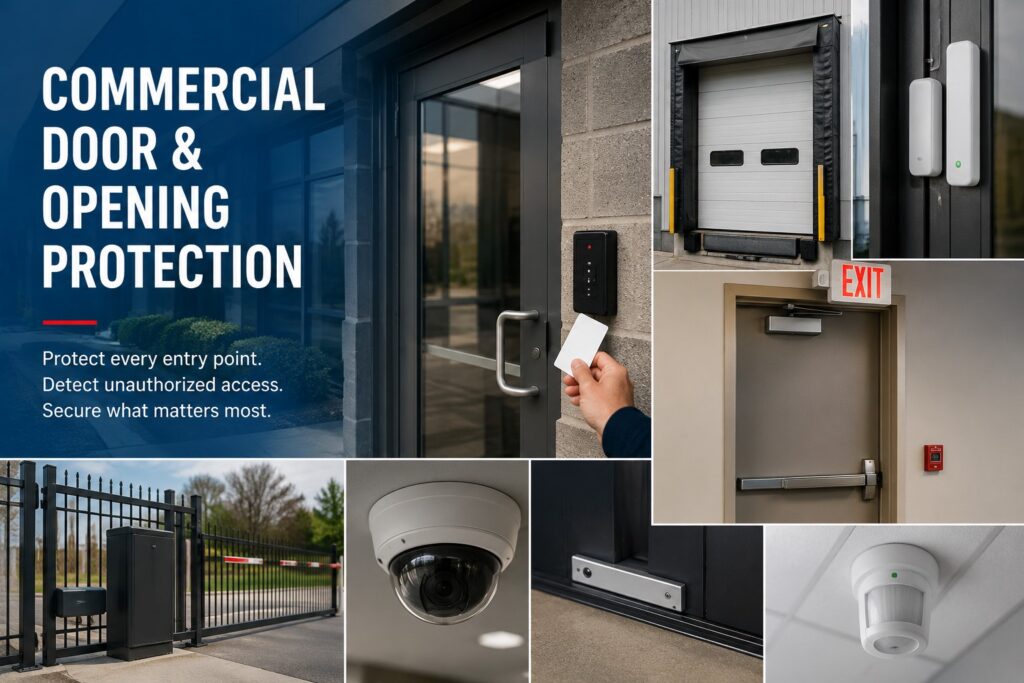
What Is Door and Opening Protection?
Door and opening protection refers to the devices and security measures used to monitor doors, gates, hatches, and other entry points throughout a commercial property.
Common protected openings include:
- Exterior personnel doors
- Employee entrances
- Emergency exits
- Shipping and receiving doors
- Loading dock doors
- Overhead and roll-up doors
- Warehouse doors
- Interior restricted-area doors
- Roof hatches
- Utility and mechanical-room doors
- Exterior gates
- Storage areas
The type of protection used should match the construction, location, operating conditions, and security requirements of each opening.
Commercial Door Contacts
One of the most common methods of protecting a door is a door contact, also called a magnetic contact or door-position switch.
The device allows the alarm system to determine whether an opening is closed or open. When the security system is armed, opening a protected door can initiate an alarm or begin a programmed entry-delay sequence.
Commercial applications may use:
- Recessed door contacts
- Surface-mounted contacts
- Heavy-duty industrial contacts
- Overhead-door contacts
- Weather-resistant contacts
- High-security magnetic switches
The correct device depends on the type of door, the environment, and the level of protection required.
Perimeter Door Protection
Exterior doors typically form part of the building’s perimeter security system.
Protecting these openings allows the alarm system to identify unauthorized access before an intruder moves farther into the facility.
A perimeter protection design may include door contacts on exterior entrances combined with motion detection or other interior devices. This layered approach helps provide additional detection if an intruder defeats or bypasses one part of the system.
Forced Entry Detection
Commercial openings may also require protection against forced entry.
A properly designed alarm system can detect when a protected door or other opening is opened while the system is armed.
Depending on the system configuration, an alarm condition may:
- Activate audible notification
- Send a signal to a monitoring center
- Generate management notifications
- Trigger associated video recording
- Identify the alarm zone or opening involved
Knowing which opening generated an alarm can help building owners, managers, and responding personnel understand where the event occurred.
Overhead and Roll-Up Door Protection
Warehouses and industrial buildings often contain large overhead, sectional, or roll-up doors.
These openings require equipment designed for the larger movement and spacing associated with commercial doors. Heavy-duty contacts are commonly used to monitor whether these openings are secured.
Additional protection may include:
- Interior motion detection
- Loading dock cameras
- Perimeter detection
- Glass-break detection
- Alarm monitoring
- After-hours notification
Large commercial openings should be evaluated individually rather than treated like standard personnel doors.
Loading Dock and Shipping Door Security
Loading docks can create unique security challenges because doors may remain open during deliveries, employee activity, or shipping operations.
Protection strategies may include monitoring loading doors after hours, separating warehouse alarm zones from office areas, and using detection devices appropriate for the operational environment.
Facilities with active shipping operations may benefit from dividing the alarm system into separate areas so sections of the building can remain operational while other areas are secured.
Emergency Exit Doors
Emergency and egress doors often require monitoring while still allowing occupants to exit safely.
Depending on the application, these doors may use:
- Door contacts
- Local door alarms
- Alarm-system monitoring
- Exit hardware
- Door-position monitoring
Security equipment installed on emergency exits must not interfere with required life-safety and egress functions.
Interior Opening Protection
Door protection is not limited to the exterior perimeter.
Commercial facilities may also monitor interior doors leading to:
- Server rooms
- Electrical rooms
- Telecommunications rooms
- Inventory storage
- Records rooms
- Cash-handling areas
- Restricted manufacturing areas
- High-value equipment rooms
Interior protection can provide another layer of security if someone gains access to the building but attempts to enter a sensitive area.
Roof Hatch Protection
Roof hatches and rooftop access points are sometimes overlooked during alarm-system planning.
These openings may provide another possible entry path into warehouses, retail properties, industrial buildings, and other commercial facilities.
Where appropriate, roof hatches can be monitored using suitable contacts or other detection methods as part of the overall perimeter alarm system.
Gate and Exterior Opening Protection
Commercial properties may also have exterior gates, fenced areas, service yards, or other openings that require monitoring.
Depending on the property, protection may include:
- Gate contacts
- Perimeter detection
- Vehicle gate monitoring
- Security cameras
- Alarm notification
- Remote monitoring
Outdoor equipment should be selected for the weather and environmental conditions of the installation.
Combining Door Protection With Motion Detection
Door contacts provide important perimeter protection, but they are often most effective when combined with additional detection.
Commercial intrusion systems may include:
- Door contacts
- Motion detectors
- Glass-break detectors
- Overhead-door contacts
- Panic or duress devices
- Perimeter detection
- Environmental monitoring
Using multiple detection methods provides broader coverage across the facility.
Alarm Monitoring
Monitoring can help ensure that security events are communicated when a facility is unattended.
When a protected opening generates an alarm, the system can transmit the event for response according to the monitoring arrangement and system programming.
Facilities planning door, perimeter, and intrusion protection can learn more about commercial alarm systems from Northeast Remote Surveillance and Alarm.
Planning Door and Opening Protection
Effective protection begins with understanding how each opening is actually used.
Important considerations include:
- Which doors lead directly outside?
- Which doors are used by employees?
- Which openings are used for shipping and receiving?
- Are there overhead or roll-up doors?
- Are roof hatches accessible?
- Which areas contain valuable equipment or inventory?
- Does the facility operate after normal business hours?
- Should different sections of the building be armed separately?
- Is professional alarm monitoring required?
The answers help determine what type of detection is appropriate for each opening.
Layered Commercial Protection
The strongest commercial security systems usually use several layers of detection rather than relying on one device.
Door contacts help protect perimeter openings.
Motion detectors help identify movement inside protected areas.
Glass-break detection can provide protection for vulnerable glass.
Specialty contacts can monitor overhead doors, gates, and hatches.
Alarm monitoring helps communicate security events when the building is unattended.
When these elements are designed together, doors and openings become part of a coordinated commercial intrusion-protection strategy.
Commercial and Industrial Applications
Door and opening protection can be used across many types of facilities, including:
- Warehouses
- Manufacturing facilities
- Distribution centers
- Offices
- Retail properties
- Schools
- Municipal buildings
- Healthcare facilities
- Storage facilities
- Multi-building campuses
The equipment and system design should always be matched to the building, operating environment, and level of security required.
Planning a Commercial Alarm System?
A professional security assessment can identify vulnerable openings, determine appropriate detection devices, evaluate existing equipment, and develop a coordinated intrusion-protection strategy for the facility.
For additional information, visit Northeast Remote Surveillance and Alarm’s guide to commercial alarm system installation.