
Commercial Interior Motion Detection
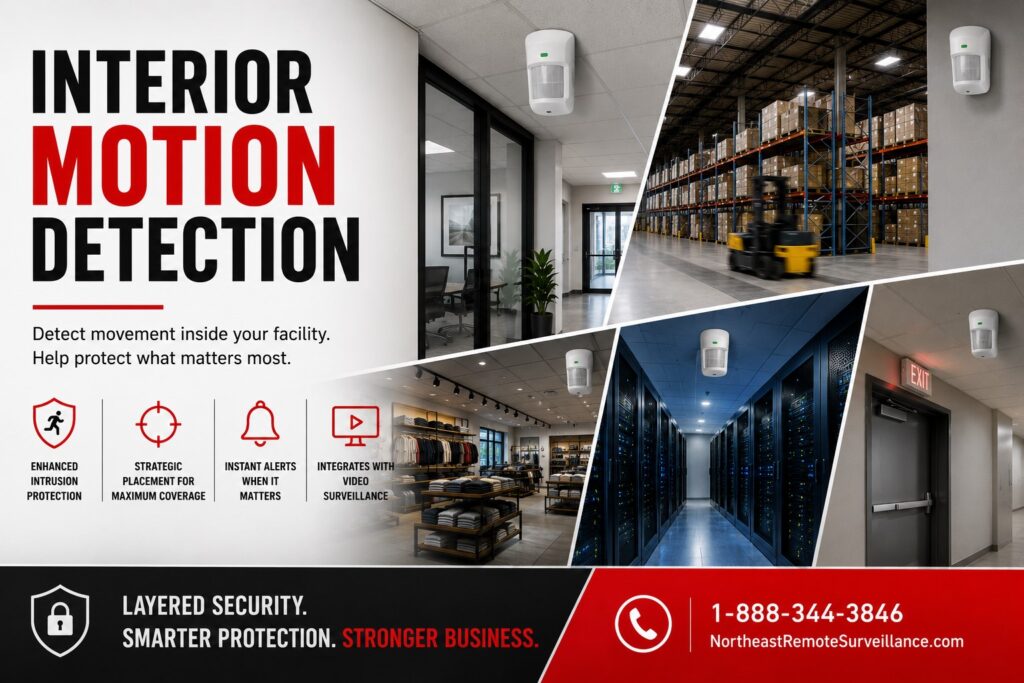
Interior motion detection provides an important second layer of protection for commercial and industrial intrusion alarm systems. While door and opening contacts help detect unauthorized entry through the building perimeter, interior motion detectors help identify movement after someone has entered a protected area.
For warehouses, manufacturing facilities, offices, retail locations, schools, municipal buildings, and other commercial properties, properly designed interior detection can provide broader coverage without requiring an individual contact on every possible pathway through the building.
What Is Interior Motion Detection?
An interior motion detector is an electronic security device designed to identify movement within a protected space.
Motion detectors are commonly installed in strategic locations such as:
- Hallways
- Warehouse aisles
- Office corridors
- Reception areas
- Lobbies
- Stockrooms
- Equipment rooms
- Manufacturing areas
- Shipping and receiving areas
- Stairwells
- Interior entrances
- High-value storage areas
When the intrusion alarm system is armed, detected movement can generate an alarm condition according to the system’s programming.
Why Use Motion Detection?
Perimeter protection and interior detection perform different jobs.
A door contact can identify when a protected door opens, but it does not normally determine what happens afterward. Interior motion detection provides another opportunity to detect unauthorized activity within the facility.
This creates layered protection.
For example, an intruder may defeat an exterior opening, enter through an unprotected area, or gain access through a portion of the building that does not have conventional door contacts. Properly placed motion detectors can provide an additional level of detection after entry occurs.
Passive Infrared Motion Detectors
Passive infrared, commonly called PIR, is one of the most widely used motion-detection technologies.
PIR detectors identify changes in infrared energy within their field of view. Movement of a person through the protected area creates changes that the detector can recognize.
PIR detectors can be effective in:
- Offices
- Hallways
- Retail spaces
- Storage areas
- Interior rooms
- Controlled commercial environments
Detector placement is important. Heating equipment, sunlight, rapidly changing temperatures, machinery, and other environmental conditions should be considered during system design.
Dual-Technology Motion Detection
Some commercial environments can benefit from dual-technology motion detectors.
These devices typically combine two detection technologies, such as passive infrared and microwave detection. Depending on the device and configuration, both technologies may need to identify activity before the detector generates an alarm.
Dual-technology detection can be useful in challenging commercial environments where reducing unwanted alarms is particularly important.
Possible applications include:
- Warehouses
- Manufacturing plants
- Large open spaces
- Mechanical environments
- Industrial facilities
The appropriate detector should be selected based on the actual operating conditions of the space.
Warehouse Motion Detection
Warehouses require special consideration because of their size, ceiling height, shelving, equipment, and changing inventory configurations.
Potential challenges include:
- Tall storage racks
- Long aisles
- Forklift activity
- Heating systems
- Loading areas
- Large overhead doors
- Changing product storage
- High ceilings
Rather than simply installing standard motion detectors throughout the building, the detection pattern should be planned around likely travel paths and areas requiring protection.
Warehouse designs may use long-range, wide-angle, curtain, or other detector patterns depending on the application.
Manufacturing and Industrial Facilities
Manufacturing environments can be more challenging than conventional offices.
Machinery, air movement, changing temperatures, dust, vibration, and production processes may affect detector selection.
A professional system design should consider what happens in the building both during normal production and after the intrusion system is armed.
A detector that works well in a climate-controlled office may not necessarily be the correct choice for a large industrial facility.
Hallway and Corridor Protection
Hallways and corridors are often valuable locations for interior detection because they create natural paths of travel through a facility.
A detector positioned correctly can help protect movement between:
- Exterior entrances
- Offices
- Warehouses
- Inventory rooms
- Stairwells
- Restricted spaces
This approach can create strategic detection points rather than attempting to place a detector in every room.
High-Value Interior Areas
Some facilities have individual areas that require additional protection even when the remainder of the building already has intrusion detection.
Examples include:
- Server rooms
- Telecommunications rooms
- Tool rooms
- Inventory cages
- Pharmaceutical storage
- Records rooms
- Cash-handling areas
- Equipment rooms
- High-value storage
- Sensitive manufacturing spaces
Dedicated interior detection can provide an additional security layer around these locations.
Motion Detection and Door Protection
Interior motion detection works especially well when combined with perimeter door and opening protection.
A layered commercial system may use:
Door contacts to detect a perimeter opening.
Motion detectors to detect movement inside the facility.
Glass-break detectors to protect vulnerable glass areas.
Specialty contacts for overhead doors, gates, and roof hatches.
Alarm monitoring to communicate security events when the facility is unattended.
Each technology addresses a different part of the intrusion risk.
Motion Detection and Video Surveillance
Motion detection can also be coordinated with video surveillance.
When an alarm occurs, cameras covering the affected area may provide valuable information about what caused the event.
Depending on the security platform, alarm events and video systems may be integrated to assist with:
- Event investigation
- Visual verification
- Identifying the affected area
- Reviewing activity before and after an alarm
- Remote security response
Video surveillance should complement intrusion detection rather than replace properly designed alarm sensors.
Reducing Unwanted Alarms
Motion detectors must be selected and positioned carefully to reduce unwanted alarms.
Potential environmental factors include:
- HVAC airflow
- Rapid temperature changes
- Direct sunlight
- Moving machinery
- Hanging signs or materials
- Animals
- Insects
- Moving curtains
- Heating equipment
- Unstable mounting surfaces
Understanding the facility’s normal operating environment is an important part of choosing and locating detectors.
Partitioned Commercial Alarm Systems
Larger facilities often need different portions of the property armed independently.
For example, a warehouse may remain protected while employees continue working in an office area, or one tenant space may be armed while another remains occupied.
Motion detection can be assigned to specific alarm partitions or areas so the security system matches the way the building is actually used.
This can be particularly valuable for:
- Warehouses
- Multi-tenant buildings
- Manufacturing plants
- Schools
- Municipal facilities
- Multi-department businesses
Planning Interior Motion Detection
Effective motion-detection design starts with understanding the building.
Important considerations include:
- Facility size and ceiling height
- Normal paths of travel
- Hours of operation
- HVAC equipment
- Manufacturing processes
- Storage rack locations
- Restricted areas
- Animals or other sources of movement
- Areas occupied after normal business hours
- Existing intrusion alarm equipment
The goal is not simply to install the largest possible number of sensors. It is to place appropriate detectors where they provide meaningful coverage while minimizing unnecessary alarm activity.
Layered Intrusion Protection
Interior motion detection is most effective as part of a complete commercial intrusion-protection strategy.
Perimeter devices can identify entry through doors and openings, while interior detectors provide another layer after entry occurs. Additional technologies can then protect glass, restricted areas, high-value assets, and specialized openings.
Facilities evaluating these protections can learn more about commercial alarm system installation from Northeast Remote Surveillance and Alarm.
Commercial and Industrial Applications
Interior motion detection can be designed for many types of facilities, including:
- Warehouses
- Distribution centers
- Manufacturing plants
- Commercial offices
- Retail facilities
- Schools
- Municipal buildings
- Healthcare properties
- Storage facilities
- Multi-building campuses
Detector technology and placement should be matched to the building rather than applying the same design to every property.
Planning a Commercial Intrusion Alarm System?
A professional security assessment can evaluate building layout, perimeter protection, interior travel paths, environmental conditions, and existing alarm equipment to determine the appropriate detection strategy.
For additional information about intrusion detection, monitoring, and commercial facility protection, visit Northeast Remote Surveillance and Alarm’s guide to commercial alarm system installation.